Can greater integration preserve an open airport eGate ecosystem?
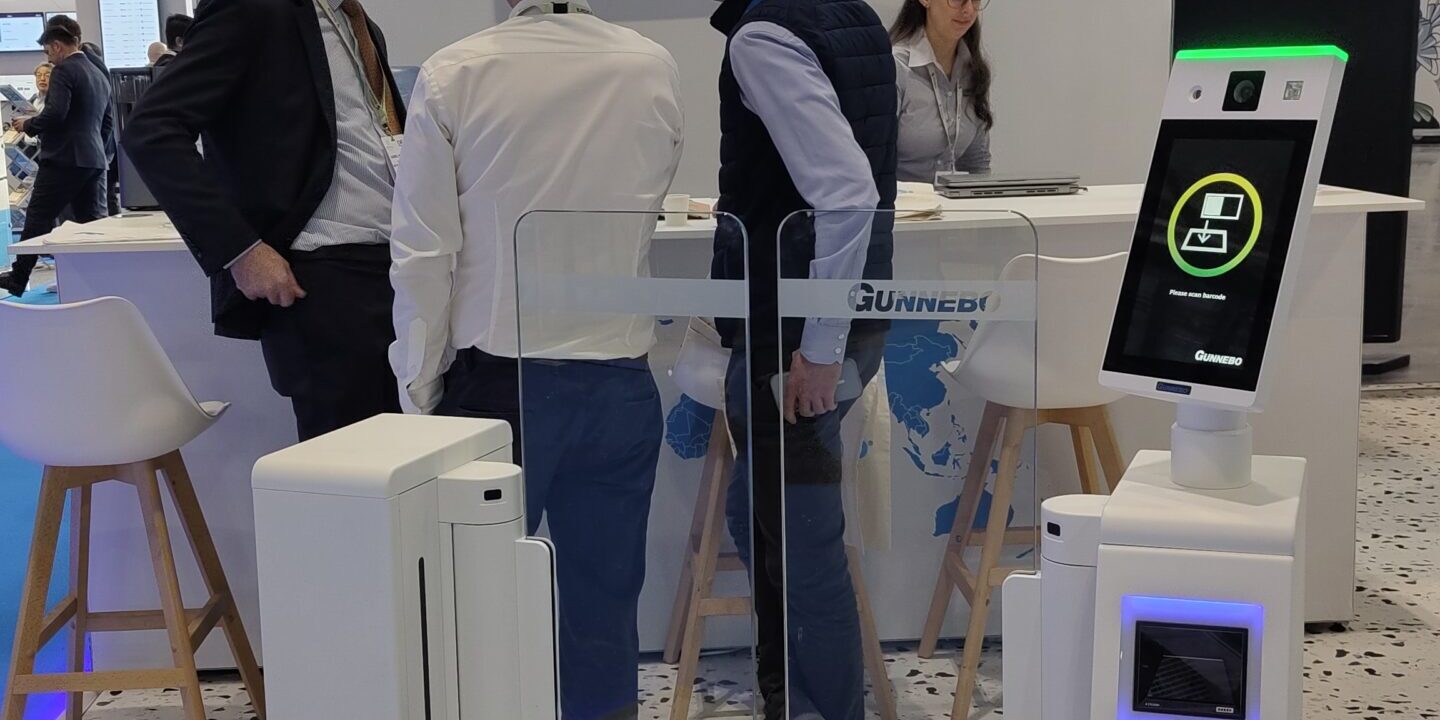
ASSA ABLOY’s proposed acquisition of Gunnebo Entrance Control is more significant for airports than a conventional expansion of its entrance control portfolio. Gunnebo gives the group an established global eGate platform, a substantial airport footprint and long-standing relationships with operators, authorities and systems integrators. Alongside HID, ASSA ABLOY would also own many of the biometric, identity and document-reading technologies that sit inside or around those gates.
The strategic opportunity is therefore to move from supplying individual components towards a more complete identity-to-passage proposition. ASSA ABLOY could design, test and support a Gunnebo gate with HID technologies as one integrated subsystem, potentially assuming a larger role in airport passenger processing and selected border projects.
Yet the strongest version of that strategy is unlikely to be a closed one. Gunnebo’s value has also come from integrating technologies from multiple biometric and systems partners. The central question is whether ASSA ABLOY can make an in-house HID configuration the easiest and most compelling option while keeping Gunnebo genuinely open to customer-selected alternatives. In a market built on both competition and cooperation, doing both may be essential.
Gunnebo brings scale where ASSA ABLOY is currently strongest
Announced on the 3rd of August 2026, the proposed transaction is expected to close in the fourth quarter, subject to regulatory approval and customary conditions. Gunnebo Entrance Control would join the Pedestrian business segment of ASSA ABLOY’s Entrance Systems division. The business generated approximately €151 million in sales in 2025, employs around 670 people and operates manufacturing sites in Europe, the United States and Asia. The financial profile matters mainly because this is an established, profitable platform rather than a distressed asset or early-stage technology.
ASSA ABLOY and HID already have airport eGate experience. The BG100 combines ASSA ABLOY’s speedgate with HID’s Facepod and document-reading technologies and has been positioned for touchpoints including pre-security, lounges and boarding, notably less so for immigration where Gunnebo’s traditional design and ImmSec platform are proven. Gunnebo does not simply fill the absence of a product; it fills a gap in scale, application depth, customer access and deployment history.
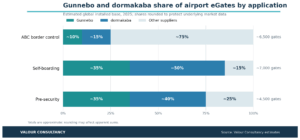
Valour Consultancy estimated in its Seamless Passenger Journey report that (as of 2025) approximately 7,000 self-boarding eGates and 4,500 pre-security eGates were installed at airports globally. Gunnebo accounted for around 36% of each installed base. Together, Gunnebo and dormakaba represented approximately 85% of self-boarding gates and 75% of pre-security gates. This makes Gunnebo one of the two dominant specialist suppliers across airport controlled passenger touchpoints.
The picture is different in automated border control. Our new report, Smart Borders 2026 – The Future of Land, Sea and Air Borders, found that of approximately 6,500 airport ABC eGates installed globally (as of 2025), Gunnebo represented around 9% and dormakaba around 15%. The market is more fragmented and more heavily shaped by national policy and procurement. A single contract covering a medium-sized or large national airport network can materially change global share. This means the acquisition gives ASSA ABLOY an important ABC platform, but not a dominant border position by itself.
From technology partnerships to an in-house proposition
HID supplies facial recognition technology, fingerprint readers, passport and identity document readers, boarding-pass readers and associated identity capabilities. Gunnebo provides the physical gate, passenger-flow controls, safety systems and application-specific enclosure. The acquisition places both sides of that interface within the same group.
That could make closer integration technically and commercially meaningful. Components could be designed into the gate rather than adapted late in a project; lane configurations could be pre-tested; sensor housings, processing hardware and cabling could be rationalised; and accountability for performance could sit with fewer suppliers. ASSA ABLOY could also use its engineering, procurement and manufacturing scale to refresh form factors and improve lifecycle economics at a time when hardware costs remain under pressure.
The result would be more than a wider catalogue. A pre-integrated Gunnebo-HID lane could give an airport, authority or prime contractor a single supported subsystem spanning identity capture, document reading and controlled passage. HID would gain a preferred route into Gunnebo opportunities, while Gunnebo would gain identity technology developed with its future products in mind.
Can integration and neutrality coexist
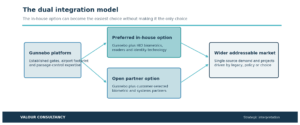
ASSA ABLOY does not necessarily have to choose between vertical integration and technology neutrality. The more relevant question is whether it can operate both models credibly at the same time.
One route would be a preferred in-house configuration in which Gunnebo and HID technologies are jointly engineered, validated and supported. The other would retain an open Gunnebo platform for authorities and integrators that have selected different biometric, document processing or border system technologies. HID could likewise continue supplying other gate manufacturers, such as EASIER, Indra, Magnetic, while Gunnebo could keep working with IDEMIA, NEC, SITA, Thales and other partners.
This type of coopetition is quite common and normal in the airport and border control sector. Procurement rules, incumbent systems, national policy, local delivery, customer preference and the allocation of project risk frequently matter more than corporate ownership. Making HID mandatory would narrow Gunnebo’s addressable market; restricting HID to Gunnebo gates would do the same to HID. The in-house option therefore needs to win through performance, integration and accountability rather than exclusivity.
Credibility will depend on execution. Partners will watch whether third-party suppliers retain comparable technical access and support, whether product roadmaps favour only HID components, and whether sales teams can manage channel conflict. Customers will judge not only whether a choice exists on paper, but whether the open route remains commercially and operationally viable.
Airsphere shows this is a market-wide challenge
dormakaba’s acquisition of Airsphere in May 2026 offers a useful parallel from the opposite direction. By acquiring Airsphere, dormakaba added passenger management software deployed at more than 250 airports and in over 8,000 eGates to an established physical gate portfolio. It has said Airsphere will continue to operate independently, supporting dormakaba customers and its existing client base.
dormakaba is therefore adding a widely deployed, hardware-agnostic software layer to its gates, while ASSA ABLOY is adding a major gate platform to a group already containing substantial biometric and identity capabilities. Both transactions point towards suppliers seeking control over more of the technology surrounding the gate without abandoning the partner ecosystems that created their reach.
The competitive comparison is no longer simply Gunnebo versus dormakaba as hardware manufacturers. It increasingly concerns how effectively each group can combine physical gates, identity technology and software while remaining acceptable to airports, authorities and integrators that require open architectures.
A gradual move up the integration stack
Gunnebo has a strong airport presence, but it is rarely the lead system integrator. Its gates are commonly supplied into propositions led by Amadeus (which also acquired egate expertise with Vision-Box, which it is planning to add to with the further acquisition of IDEMIA Public Security), SITA, Collins Aerospace and other airport systems specialists that bring operational software, airline and airport integrations, project management, local support and responsibility for the overall solution.
The acquisition gives ASSA ABLOY a stronger position inside those projects, but not immediate control over them. A realistic progression is from component or gate supplier, to provider of a pre-integrated gate subsystem, to lead supplier for a complete automated checkpoint and, selectively, systems integrator for defined passenger-processing applications.
That progression is most plausible first at airport-controlled touchpoints such as pre-security, boarding, lounges and staff access. At immigration, ASSA ABLOY could address more of the passenger-facing lane, but border management systems, watchlists, immigration rules, national entry-exit platforms and government networks remain outside the physical checkpoint. Established government technology providers and prime integrators will remain critical.
This creates another layer of coopetition. SITA, Amadeus, Thales, IDEMIA and other integrators may value a pre-tested subsystem that reduces engineering and integration effort, even while ASSA ABLOY competes for a larger share of selected projects. The group does not need to become a national border management provider to move meaningfully up the value chain.
Competitive implications and what to watch
For dormakaba, its closest large-scale rival in airport gate hardware gains far greater identity depth. For biometric and reader suppliers, HID gains a natural internal route into Gunnebo deployments, although customer specifications will preserve opportunities for alternatives. For airport and border integrators, ASSA ABLOY becomes both a more capable subsystem partner and a potential competitor for larger work packages. Smaller gate suppliers may also become more attractive to technology vendors seeking an independent hardware platform.
The first indicators will be practical rather than rhetorical: HID components becoming preferred options across Gunnebo’s portfolio; jointly engineered lane configurations; common diagnostics and service tools; refreshed gate designs; and ASSA ABLOY leading broader passenger-processing bids. Equally important will be evidence that Gunnebo continues winning projects with third-party identity suppliers and that HID remains active across competing gates.
The acquisition’s greatest potential lies in running both models successfully. If ASSA ABLOY combines Gunnebo’s scale and sector relationships with HID’s identity technologies while preserving credible interoperability, it can serve customers seeking consolidation without surrendering opportunities defined by choice, legacy systems or national policy. If it closes the platform too aggressively, it risks weakening the partner reach it is paying to acquire. If it treats Gunnebo only as additional hardware scale, it leaves the more distinctive integration opportunity unrealised.
Note: for up to date analysis and airport-level data of automated, biometric and self-service airport touchpoints, contact us to enquire about the Smart Airports Tracker.