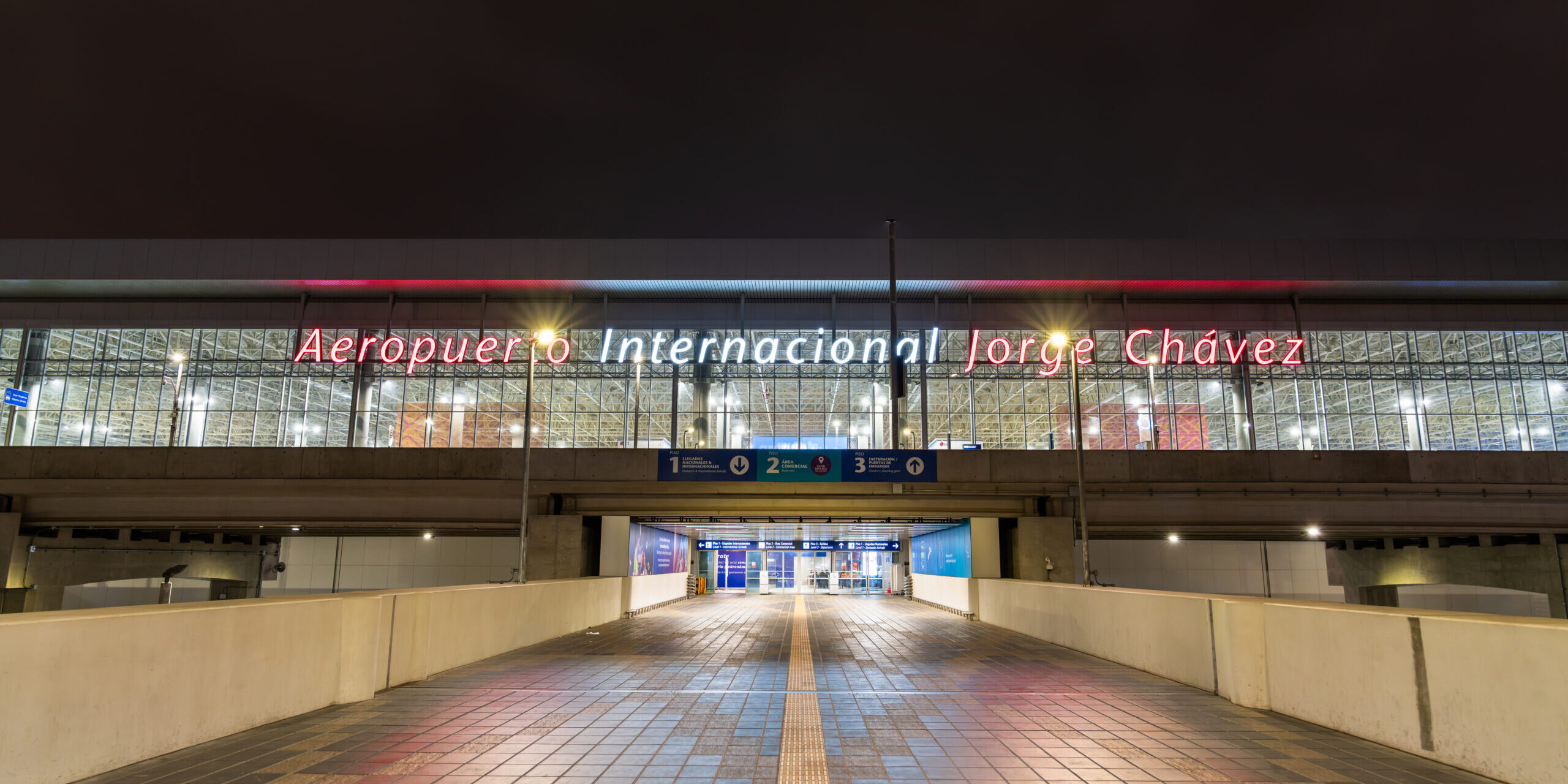
Last year, six months before the start of the on-off war in Iran that sent the price of Jet-A surging and made long-haul family travel ever more expensive, I was lucky enough to journey to Lima, Peru, spending the kids’ school holidays working from the culinary capital of the world. In addition to sampling lots of ceviche, papa rellena and, of course, plenty of pisco, the trip gave me the opportunity to get a first-hand view of the newly opened terminal at Jorge Chavez International Airport (LIM). In this article, I examine whether the operator succeeded in its vision to deliver a seamless passenger experience.
Before we begin, it is worth noting that we arrived into Lima in July 2025, about a month and a half after the new terminal’s official opening on June 1st. So, it’s fair to say that teething problems were to be expected. And while initial impressions of the modern structure itself were positive, the ability to get through border control was anything but. In fact, it took our family of five almost two hours to get to the front of the snake-like line and speak with the immigration official.
And you might ask why it took so long to even get to the point of presenting our passports? Well, I learnt afterwards that despite the new terminal’s massive size (it is roughly three times the footprint of the previous facility), the international arrival area is actually around 20% smaller than its predecessor. So, when multiple wide-body flights land at the same time – as they often do in an airport pitched as South America’s first true Airport City and a major continental hub – bottlenecks inevitably occur. Big ones.
Compounding this problem is the fact that Peru has shifted to systematically capturing biometrics for all foreign visitors, including minors. This involves being processed manually at staffed desks where both fingerprint and facial biometrics are captured. My children, aged 9, 6 and 3 at the time, did what children do. They’d been travelling for almost 24 hours and understandably struggled to stay in line, were in no mind to listen to instructions and placed sticky fingers on fingerprint readers. I didn’t time it but we must have spent at least 20 minutes at the counter while the laborious process of placing and replacing fingers and thumbs on the scanner took place.
Previously, at the old terminal, children processed at staffed desks were not routinely fingerprinted or photographed for biometric enrolment and families were brought through a designated lane. In fact, the experience was once quite pleasurable, with old LIM praised for its efficiency, layout, and amenities. So much so that it actually won the “Best Airport in South America” award seven years running. This “new and improved” update, by contrast, has been widely panned by travellers who’ve taken to platforms like Tripadvisor and Reddit to express their frustration.
Anyone reading this not already familiar with LIM is most likely thinking that there must be some form of automation used at border control to expedite the process. And there is. But despite the airport heavily promoting the availability of new SITA ABC eGates and biometric kiosks on arrival, these are restricted to adult Peruvian citizens and legal residents who have pre-registered via the MigraCheck app. Thankfully, the experience on departing the country has since been somewhat improved, with foreign tourists aged 18+ who entered through LIM and have an electronic passport now able to use the outbound eGates, provided they complete MigraCheck pre-registration within 48 hours of their flight.
Sounds a bit more seamless on the way out then. Right? In theory, yes. But in our case, it was the cause of frustration that could bring out the Michael Douglas-in-Falling-Down character that lurks within us all. You see, when you arrive in Peru, the immigration official will ask how long you plan to stay in the country. On departure, if it is found that you’ve exceeded that timeframe, you will be forced to pay a fine before you can leave. Typically, visa-exempt tourists, including citizens of the UK, US, Canada, Australia and the EU, are granted up to 90 days, although it remains at the discretion of the person you happen to interact with. Despite making it clear that we were staying with family for six weeks, we discovered shortly before our departure that our digital entry record – rather than a passport stamp, which had been phased out in 2023 – gave us only four weeks. And so we had to pay a fine. I understand that the authorised period of entry is ultimately up to the border official, but I can’t help but wonder why travellers are even asked how long they intend to stay for if it effectively rests on an individual whim?
And before anyone says anything about this being the inevitable result of my awful Spanish, my wife is from Peru and speaks Spanish fluently. There could therefore be no doubt in anyone’s mind about the length of time we were staying for!
Overall, and unlike the food in Peru, the new LIM airport experience was one that didn’t leave a great taste in the mouth. A new terminal was undoubtedly a necessity as the old one was bursting at the seams. But new doesn’t always equate with good and this is a classic example of poorly implemented infrastructure and a lack of joined-up thinking. Aside from the problems we encountered, getting to and from the airport can also be a nightmare. As it stands, the new terminal is accessible exclusively via two temporary, prefabricated steel bridges over the Rímac River. These will eventually make way for the permanent Santa Rosa bridge, but the project has faced endless bureaucratic setbacks and is officially delayed until 2029. As such, travellers are completely dependent on the hugely congested road network, while plans to provide a direct metro connection to the terminal remain unresolved, with no confirmed completion date.
In the interests of balance, I realise I’ve said little about the wider experience at LIM, including check-in, baggage, security, wayfinding, retail, facilities or boarding. And there was nothing inherently right or wrong with how things were handled at these touchpoints. It all still felt very manual, though, and after such a long wait trying to get into the country, our bags had already been taken off the luggage carousel and were quickly in our possession. Don’t get me wrong: it’s a nice new building, the staff were pleasant, and check-in, bag drop and security were all much the same as anywhere else in the world. But nothing left me thinking, “Wow, this new technology made my journey a breeze.” And ultimately, that’s what was missing from an organisation claiming it would deliver a seamless and efficient passenger experience.