Introduction
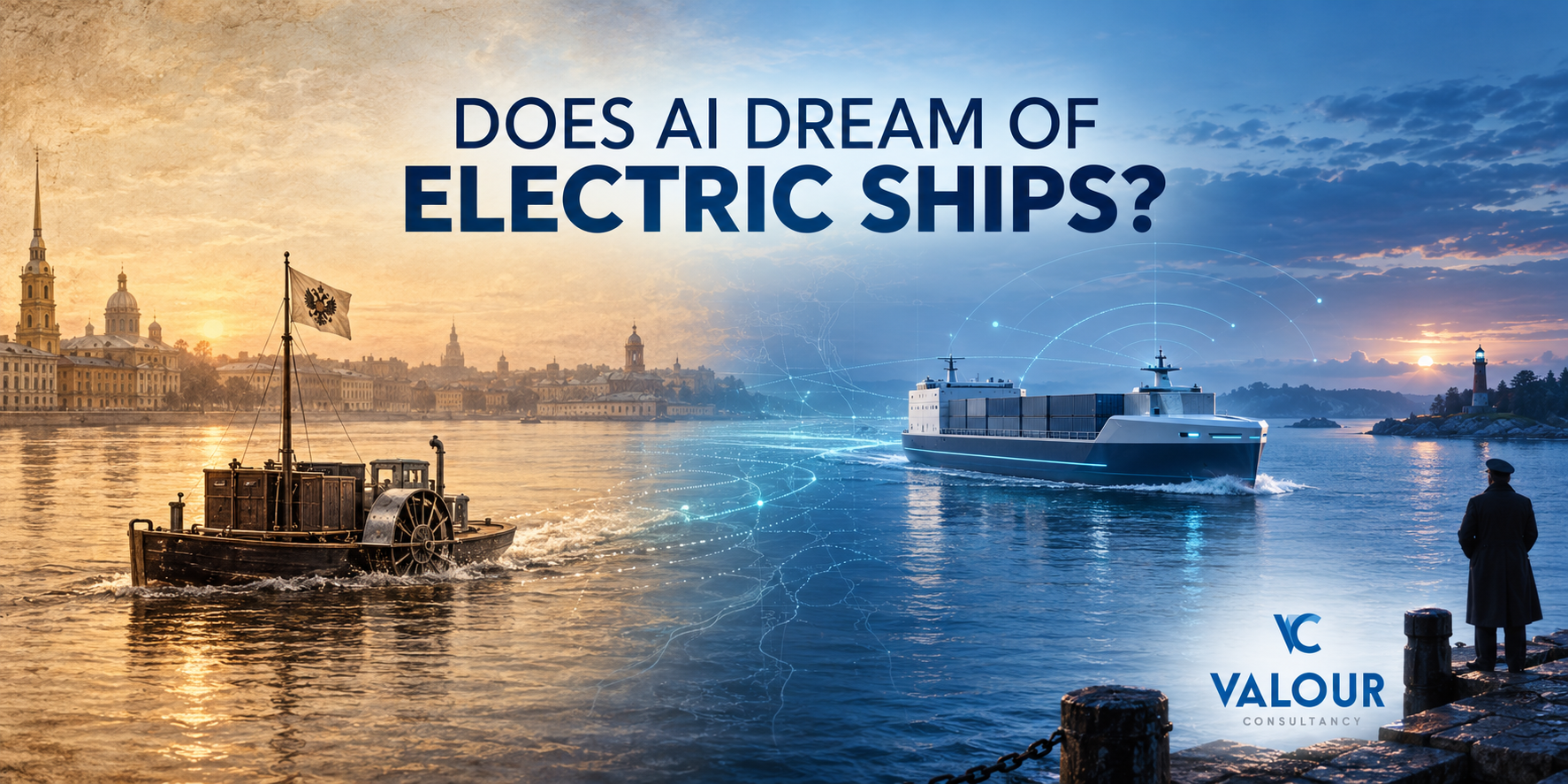
The idea of electric propulsion for ships stretches back nearly 200 years to a Prussian electrical engineer and physicist, Moritz Hermann von Jacobi, who deduced the maximum power theory and, later, built a 28-foot paddle boat for Tsar Nicholas I. This ferry, in 1838, was powered by lead zinc batteries and was able to carry 14 passengers at 3 knots across the Neva River in St Petersburg against the tide.
While not yet mainstream, there are electrically powered vessels all over the world. Japan, South Korea, China, Singapore, India and even the USA all have electrically powered vessels, including cargo carriers, bunker tankers, ferries and tugs plying their trade. Europe has been a major force with companies such as Zulu Associates of Belgium and the Norwegian company Kongsberg (previously Rolls Royce) leading the way for larger commercial vessels while other companies such as Orca AI and Kraken Technology focus on smaller USVs.
In Japan, there are four demonstration vessels, a Ro-Ro, two containerships, and an inter-island ferry built under the MEGURI2040 project launched in 2020 by The Nippon Foundation. In South Korea, SK Shipping and HD Hyundai Group, and Avikus, are developing a certifiable design for next-generation autonomous ships.
In China, the Zhu Hai Yun is an AI-powered intelligent research ship capable of autonomous navigation and multi-agent coordination and can act as a mothership to autonomous drone fleets. In addition, the Ning Yuan Dian Kun operates as a massive all-electric, intelligent container ship with automated navigation features.
Singapore has tested Smart Maritime Autonomous Tugs (SMAV) for port work and is developing crew-less container-transfer vessels moving goods between terminals like Tuas and Pasir Panjang. India has autonomous offshore patrol vessels and the USA has autonomous military vessels and some smaller tugs and research vessels.
It is not all plain sailing, however. In Norway, the Yara Birkeland which commenced commercial operations in early 2022, and has now completed over 250 voyages transporting containers filled with premium fertilisers over 11 nautical miles, is still required to have a crew of 2 or 3 on board, although capable of complete autonomy and driven by two 900kW Azipull pods, and two 700kW Tunnel thrusters. This is down to regulatory and insurance issues which bedevil the process. According to the latest articles, mooring is still done manually, with tests underway on the ship’s robotic mooring arms. Tests will soon start on the Yara Birkeland’s AI situational awareness system. The AI system controls how the ship navigates, based on decisions it makes on its surroundings, other ships, obstacles, or weather changes.
These test builds are mostly being touted on their environmental and ecological benefits, but until the economic benefits become unassailable, take-up will be slow. A fleet of economically successful unmanned coastal and inland traders would shake up the industry faster than a minnow can swim a dipper.
The Design of Electric Autonomous Ships
Autonomous commercial shipping, at first glance, would seem to be confined to large fleet owners of coastal, inshore and inland waterway traders. A marathon of regulatory hoops would seem to preclude international trade at the moment.
Whereas traditional maritime trade vessels have evolved over time, bringing about a functioning electrically powered (or hybrid sail-plus) autonomous vessel requires it to hit the ground running from a standing start. The vessel concept is possibly the simplest sub-task. From there, design, build, commissioning, speed trials and class, flag and insurance acceptance start the process. Next must be considered port operation, open water operation, crowded water operation, maintenance, loading and unloading, planned and controlled scrappage, and refuelling. For inland waterways, there is the issue of operation in low water levels when old river works are nearer the surface and in high levels when forest debris is washed down from the hills and mountains. The problems facing a designer would seem to be endless, which is why dedicated designers such as Zulu Associates are vital.
To recharge marine batteries or maybe even swap out power banks would seem to be beyond the scope of supply for most ports. Valour Consultancy has long advocated the use of decommissioned oil and gas platforms to house modular nuclear reactors and, given there are many platforms within inshore waters and close to major maritime hubs, these would seem perfect for relatively inexpensive recharging facilities. After all that is examined, come the commercial aspects such as chartering, or even a parcel delivery concept. Companies such as Zulu Associates are taking all this on board as part of their offering to the shipping industry.
Autonomous Maintenance Stratagems
One of the major problems facing unmanned operation is that every trip must be maintenance and problem free. In existing vessels designed for unmanned survival or operation, this is achieved by high degrees of redundancy. This makes these vessels expensive. Designers now create well-designed standardised systems, sensible levels of sensor redundancy, good access to marine drivers and shaft seals, proper maintenance of main drivers and ancillary cooling systems, easy access to cooling water intakes, clear documentation and maintenance crews who understand how the vessel works. Essentially designers are replacing redundancy with high degrees of reliability. Standardised design also allows a holistic approach to improving vessel efficiency and reliability. Scalability of a wide range of vessel types that make up a typical fleet presents problems in itself as motive power requirements for a coastal trader versus for river transport are different.
What AI does not do as effectively as a marine engineering team is diagnose and determine the actions needed to remedy a risky situation. Even if there is a team in every port capable of standard maintenance for the range of vessels likely to berth, there needs to be a maintenance repair hit team ready to fly to vessels drifting afloat. These need to be highly-skilled engineers, able to transit through any country at short notice and who spend a lot of their time idle. This is a recipe for freelance sub-contractors and not employees of the fleet owners.
Ancillary Considerations
Electric propulsion is not good for large vessels. The largest electric motor (36.5 megawatts) is only two-thirds the size of the engine driving the largest boxship (56.8 megaWatts after de-rating) and, for reliability, a good rule of thumb is never buy the largest nor the smallest in any range of products.
However, electric drives and systems tend to be far more reliable and need less maintenance than either hydraulic, pneumatic or mechanical systems. 5-10 megawatt motors are available and widely used in the offshore drilling industry with solid-state speed control so autonomous ships up to a certain size would be relatively reliable, and fairly easy to maintain. The systems would be somewhat more expensive than current marine diesel, and detailed cost accounting would be needed to assess the relative returns. The returns, in terms of safety and a decrease in insured damages, and absence of on-board crew costs might easily tip the scale in favour of autonomy.
There can be little doubt that autonomous vessels for inshore, lakes and inland waterways are sensible where they do not come into contact with leisure water users. Many cities are equipped with an extensive waterway infrastructure that is often barely occupied by commercial users and therefore holds significant potential for the relocation of transport from the road onto the waterways. The benefits of this could be extensive, more pertinently increasing profitability and diminishing road congestion and air pollution.
Valour Consultancy examines the technologies, companies and commercial models shaping autonomous and electric shipping. Explore our maritime research for further analysis of vessel autonomy, smart shipping and maritime connectivity.
*A Note on the Title
The title of this article is a reference to Philip K Dick’s 1968 seminal science fiction novel “Do Androids Dream of Electric Sheep?” In 1982, it was made into the film “Blade Runner”, directed by Ridley Scott. It starred Harrison Ford and Rutger Hauer. Before dying, the character, an android played by Hauer, gave an impassioned speech “I’ve seen things you people wouldn’t believe. Attack ships on fire off the shoulder of Orion. I watched C-beams glitter in the dark near the Tannhäuser Gate. All those moments will be lost in time, like tears in rain. Time to die.”
Autonomous electric shipping will replace some of the drudgery and boredom that is 95% of the life of a worker in the maritime industries. However, amongst those moments of tedium, the romance of seagoing comes alive and a sailor will see and feel things that landlubbers are denied. There are many advantages to removing crew from ships but there are some losses too.