Drone delivery has seen many years of disappointing growth, perhaps best evidenced by Amazon’s difficulty getting Prime Air off the ground despite delivering billions of packages across the globe. The largest barrier has been lack of regulatory approval, which many operators have struggled to overcome.
However, in recent months, drone delivery may finally be coming into its own. Not to replace delivery drivers in some futuristic society but as a layer in a complex, multi-modal delivery network that aims to expand its services and audience without relying on traditional infrastructure. The future isn’t drivers or drones, it’s drivers and drones.
So, what’s changed?
For a long time, delivery drones were sold as a revolution that would overhaul trucks, cars, bikes and, ultimately, people. They now appear to have found a more practical niche and are being deployed where they can solve specific pain points. For example:
- Mid-range distances susceptible to traffic, where a car is required but delivery becomes slow and expensive relative to the value of the order.
- Ultra-fast convenience delivery not possible using road infrastructure.
- Regions where road infrastructure is limited or congested such as island communities.
Drone delivery doesn’t need to replace drivers to scale. It actually seems to be finding more success as a tool that addresses inefficiencies in ground networks, improves delivery speeds, and expands food and retail platform reach to serve hard-to-reach locations or affluent customers that are willing to pay for ultra-fast delivery. The following news roundup shows how far operators and consumers alike have begun to embrace that more targeted role in the US.
The US Takes The Lead
For years, American drone enthusiasts looked at Europe with a bit of envy. European regulators Had adopted more standardised frameworks to approve BVLOS operations in certain environments, making it simpler than earning waivers on an individual basis in the US. However, the tables have turned and more recent traction has occurred stateside. We suspect this might be a result of the imminent Part 108 rules that will authorise and regulate routine BVLOS flights for delivery and other drones. In anticipation of regulatory barriers crumbling by the end of 2026 or early 2027, delivery drone operators are setting their aims high:
- Wing and Walmart announced expansion plans taking their footprint to over 270 stores by 2027.
- Zipline’s partnership with Uber targets one million drone deliveries per day in the US by the end of 2029 .
- Amazon Prime Air has plans to expand to nearly 500 US cities by the end of 2026, up from fewer than 100 today.
- Manna has shifted its focus to the US market and is targeting 40 bases nationwide.
- DoorDash is launching DoorDash Air, its own inhouse delivery programme, after becoming the eighth operator in the US to obtain Part 135 Certification. The firm is even developing its own drones, alongside partnerships with Wing and Flytrex.
- GrubHub has joined the drone club and obtained a Part 135 Certificate to operate UAS from partner Dexa for trials in New Jersey.
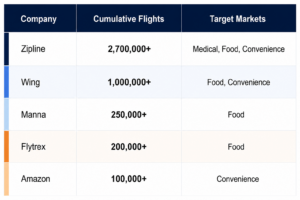
While these future plans are encouraging, where is the market actually at today? Figure 1 shows cumulative global flights for key delivery drone operators active in the US. While these milestones mark major achievements, only a portion have occurred in the country. In contrast, Valour Consultancy forecasts that more than 28 million annual drone delivery flights will take place in North America by 2030, with a majority in the US, showing just how much room there is for domestic growth. This outlook is much more modest than Zipline’s target of 365 million annual deliveries in the US by 2029.
Figure 1. Cumulative Global Flights of Key Delivery Drone OEMs (That Operate in the US): 2026
Source: Valour Consultancy
The Two Keys To Scale
The first key is integration into existing delivery networks. The drone delivery market no longer relies on vertically-integrated OEM/operators; Uber, DoorDash, Walmart, Amazon and Grubhub are increasingly shaping the landscape. Drone operators are essential in providing aircraft, training and operational expertise, but third-party operators grant access to a customer base in the millions and addressable market in the billions (trips per year).
The integration of drone technology into these platforms may have burst the “replace all drivers” bubble, but it has also enabled the survival and scale of drone delivery technology. The commercial value of delivery drones depends less on whether the technology works in isolation and more on whether the economics make sense. What better way to calculate this than integration into a delivery platform that can decide, in real time, when a drone is better than a driver, van, bike or walker, then coordinate accordingly. Drone OEMs, meanwhile, benefit from access to a much bigger addressable market than they could build from scratch, while food and retail delivery platforms benefit from a relatively low-investment and sustainable technology that can expand delivery networks faster than road infrastructure and labour supply alone.
Ultimately, reduction in cost and improvement in service – real demonstrable benefits – will be what unlocks new markets, rather than expecting adoption to come from implied theoretical superiority over road delivery.
The second key is regulation. While there is potential for US regulation to enable the market to scale, this hinges on how and when Part 108 rules are officially defined and enacted. Though recent growth and expansion targets demonstrate proven demand for drone services and great potential, delivery drones need to be able to fly BVLOS routinely, across more diverse environments, and using standardised frameworks that allow for faster and safer approvals.
Currently, the only UAS-specific rules fall under Part 107, which allows drones to be flown within visual line of sight. Beyond this, the FAA has granted individual waivers. One such waiver, however, requires the operator to prove safety across a variety of conditions including one pilot operating multiple drones and operations over people and moving vehicles. Once these safety capabilities have been reviewed and approved, the FAA will often add limitations such as set corridors and operating hours as well as limits on the drone-to-pilot ratio. Not to mention, reviewing and approving every single different operator takes time. Consequently, while BVLOS package delivery has been possible, the lack of a standard assessment and approval process has become a bottleneck for scale.
Valour Consultancy believes that defined Part 108 rules are necessary for new targets to be reached, despite adoption of the technology amongst major delivery platforms and demand from customers for drone delivery services. Read more about our conclusions and our forecast for the drone delivery fleet out to 2050 in our latest report “The Future of Commercial Drones – 2026”. We dive deeper to explore optimistic and pessimistic scenarios based on regulation as well as other factors such as public acceptance, operating costs and demand.

Summer Staninski, Author