For years, the low-cost carrier (LCC) market has represented one of the aviation industry’s greatest untapped opportunities for in-flight connectivity (IFC). While full-service airlines steadily invested in onboard Wi-Fi to enhance the passenger experience, many LCCs remained unconvinced. High installation costs, uncertain monetisation and an absence of competitive pressure meant that connectivity was often viewed as a luxury rather than a necessity.
That picture is now beginning to change.
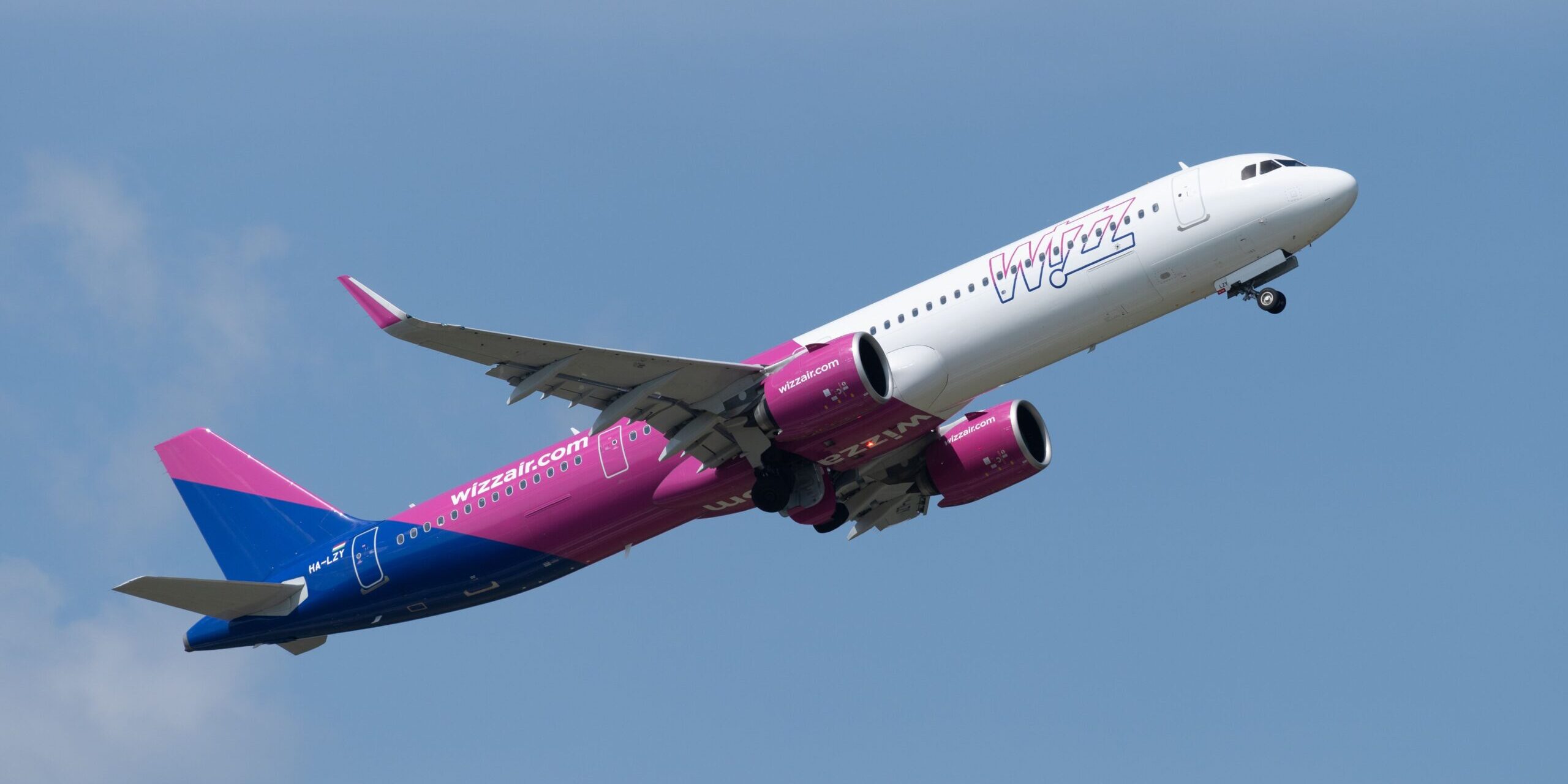
So far this year, the market has seen a series of significant announcements that suggest the LCC sector is entering a new phase of IFC adoption. Most notably, Indigo Partners – the private equity firm behind some of the world’s largest ultra-low-cost airlines – has committed to deploying Starlink across its portfolio. The programme includes Wizz Air (Hungary), Frontier Airlines (United States), Volaris (Mexico), JetSMART (Chile) and Cebu Pacific (Philippines), representing more than 1,000 aircraft. In Latin America, Viva has selected SES‘ multi-orbit connectivity solution, demonstrating that momentum is not limited to a single supplier.
Global LCC Fleet – Facts and Figures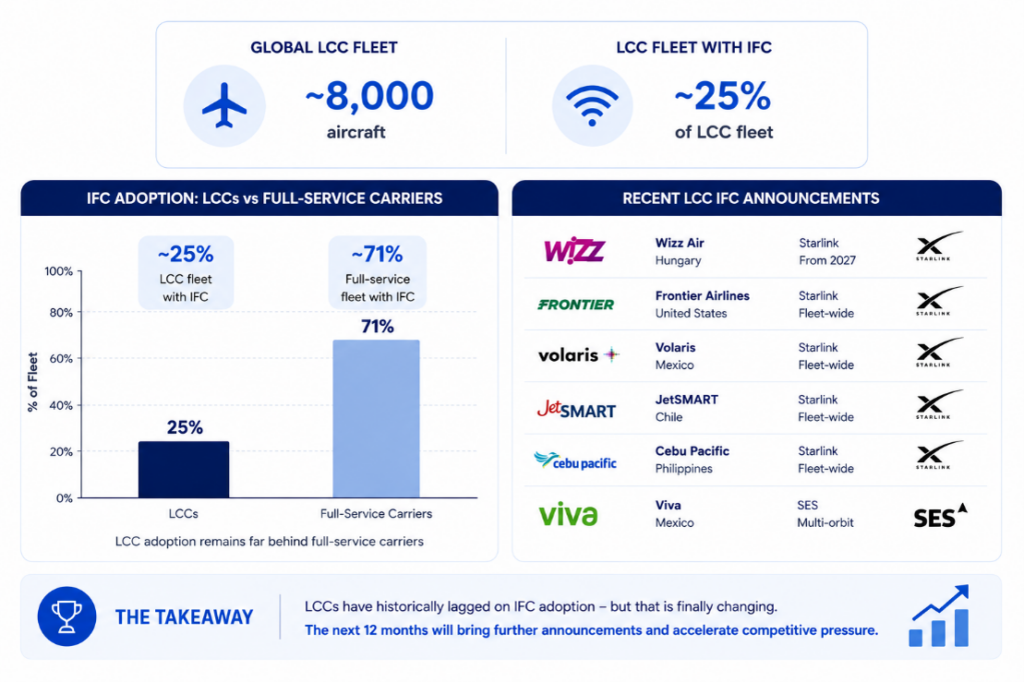
Source: Valour Consultancy
These announcements matter because the LCC market has historically lagged far behind the rest of commercial aviation. Valour Consultancy estimates that only around 25% of the global LCC fleet is currently equipped with IFC, and even this figure somewhat overstates adoption. Southwest Airlines – the world’s largest LCC – accounts for roughly one-third of all connected LCC aircraft, meaning connectivity across European and Asia-Pacific low-cost fleets remains particularly limited. And this 25% figure sits significantly below penetration levels seen among full-service carriers – which stands at around 71%.
The reasons are understandable.
LCCs have built their business models around ruthless cost discipline. Every additional kilogram, every maintenance event and every new onboard system must justify itself financially. Historically, many airline executives simply concluded that passenger Wi-Fi failed to generate an acceptable return on investment (ROI).
No airline has embodied that scepticism more publicly than Ryanair. Earlier this year, CEO Michael O’Leary and Elon Musk engaged in a highly publicised exchange over the economics of Starlink connectivity after O’Leary questioned whether the numbers stacked up for Europe’s largest airline. Regardless of the headlines, the exchange reflected a genuine debate taking place throughout the industry: does the ROI for IFC make sense?
Increasingly, the answer appears to be yes.
The business case for IFC has evolved considerably over the past few years. Connectivity is no longer viewed purely as a passenger amenity. Airlines are beginning to recognise its broader strategic value – from improving customer satisfaction and loyalty to enabling ancillary revenue opportunities, operational efficiencies and richer digital engagement throughout the passenger journey. New commercial models – including sponsored connectivity and mobile network operator partnerships – are lowering barriers to adoption. The emergence of faster installation techniques has also reduced aircraft downtime, making retrofit programmes more attractive than ever before.
Competitive dynamics are also changing.
As more LCCs begin offering reliable, high-speed Wi-Fi, those that remain disconnected risk falling behind passenger expectations. What was once viewed as a differentiator increasingly looks like table stakes. Once a handful of market leaders commit, competitive pressure has a tendency to accelerate adoption across the rest of the sector.
For that reason, Valour Consultancy expects the next 12 months to bring further announcements from low-cost airlines that have yet to define a long-term IFC strategy. Several sizeable LCC fleets across Europe, Asia-Pacific and the Middle East remain unequipped, representing one of the largest remaining greenfield opportunities in commercial aviation connectivity.
The timing could also prove significant for Amazon Leo.
Although Starlink has established an early lead within the LCC segment, Amazon Leo is expected to equip its first commercial aircraft towards the end of 2027. The satellite operator is likely to place a strong emphasis on performance, commercial flexibility and competitive pricing. The LCC segment accounts for more than 8,000 aircraft and offers huge opportunities for IFC suppliers like Amazon. If the company can offer airlines a compelling commercial proposition alongside high-quality connectivity, it has an opportunity to accelerate the next wave of adoption.
The LCC market has long been regarded as the missing piece of the IFC puzzle. Recent announcements suggest that piece is finally beginning to fall into place.
Want to learn more?
Valour Consultancy’s Amazon Leo Aviation Deep Dive – 2026, publishing this month, explores Amazon’s aviation strategy, competitive positioning and ten-year market forecasts in detail.