
August 6 2026, 14:00 British Summer Time (BST)
London. New research from Valour Consultancy forecasts that non-geosynchronous orbit (NGSO) Ka- and Ku-band in-flight connectivity (IFC) installations in business aviation will reach 8,500 by 2035 as high-speed low Earth orbit (LEO) connectivity becomes the preferred primary cabin solution. The finding is one of the headline conclusions from Valour Consultancy’s latest report, ‘The Market for IFC in Business Aviation – 2026’, which examines how LEO connectivity powered by Starlink, OneWeb and incoming networks from Amazon, Telesat and Spacesail is expected to shape the market between 2025 and 2035.
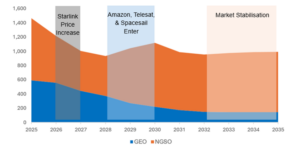
Figure 1. Annual Installations of Ka- and Ku-band IFC by Orbital Shell: 2025-2035
Source: Valour Consultancy
Business aviation is transitioning away from GEO as the primary cabin connectivity technology and toward LEO-centred solutions. Passengers increasingly expect an office-in-the-sky experience, where IFC supports video calls, cloud collaboration, streaming, secure corporate network access and other live applications that require high throughput and low latency. While GEO Ka- and Ku-band systems will remain important for redundancy and coverage over regions where LEO networks remain unapproved, their role is expected to evolve as back-up connectivity.
Starlink has been the clearest catalyst for this transition. Its strong brand power, first-mover advantage, rapid installation cycle, competitive pricing and electronically-steered antenna (ESA), which can fit on almost any size aircraft, created a step-change in demand for LEO Ku-band connectivity. Gogo’s OneWeb-powered Galileo then launched in 2025 with two differentiated solutions: half-duplex (HDX) for smaller aircraft and full-duplex (FDX) for larger jets. Gogo is expected to be a formidable opponent to Starlink as it has a diversified LEO offering and the ability to offer multi-orbit and multi-network services, including Galileo, GEO and air-to-ground (ATG) connectivity.
LEO growth accelerated further in 2025 as Starlink and Galileo gained traction in North America and Europe. Growth is expected to expand beyond these regions as Gogo’s broader coverage proposition supports demand across regions where Starlink’s regulatory approvals and service availability remain more limited, including parts of Africa, Asia-Pacific and the Middle East.
While Starlink’s July 2026 price increase is likely to dampen adoption among more price-sensitive customers, the impact is likely to be less pronounced among large cabin and super midsize jet operators, where connectivity costs represent a smaller share of total aircraft operating expense. These more price-sensitive, smaller jet segments can still effectively be served by Gogo’s HDX, so Valour still expects strong LEO take-up.
“LEO has quickly set expectations around cabin connectivity in business aviation,” said Summer Staninski, Senior Analyst at Valour Consultancy. “Owners and passengers are now asking for low-latency, high-speed IFC, and that has forced the rest of the market to respond. The big question is what do GEO operators do now?”
In the short term, GEO is still important for coverage across regions throughout Asia-Pacific, Africa and the Middle East. Viasat and SES will retain their position among the highest-value segments housing Heads of State, C-Suite executives and other customers with larger jets and bizliners that have complex connectivity needs and require consistent coverage and redundancy all over the globe. However, the story may be different in the long run.
The next wave of disruption is expected to come from incoming LEO networks. Amazon Leo will make waves with Amazon’s brand power, scale and ability to bundle connectivity with services such as Amazon Web Services (AWS) and Prime content. This could give Amazon a differentiated value proposition, particularly among corporate fleets and passengers already embedded in the Amazon ecosystem.
Telesat Lightspeed and Spacesail are expected to enter shortly after. Telesat is likely to support multi-orbit Ka-band propositions through established partners, while Spacesail’s global LEO Ku-band network is likely to gain regulatory operational approvals in regions where Western LEO networks have faced challenges in doing the same, particularly China. Over time, LEO-LEO redundancy may emerge, with aircraft using different LEO networks across different regulatory regions rather than relying primarily on GEO as a back-up.
“By the end of the forecast period, the market for IFC in business aviation is mostly LEO,” added Staninski. “This is likely to apply across aircraft segments and regions, although the exact solution will vary by aircraft size, mission profile, budget and regulatory environment. GEO will not disappear, but its role increasingly shifts toward redundancy, premium global users and coverage edge cases. For most aircraft, where coverage and economics align, a LEO-only solution will be sufficient.”
Report Summary
Valour Consultancy is a multi-award-winning provider of high-quality consultancy services and market intelligence across the global mobility market. Its latest report, ‘The Market for IFC in Business Aviation – 2026’, is useful for fleet operators choosing connectivity, investors, vendors, aircraft OEMs, MROs and anyone with an interest in understanding the market. It assesses the impact of LEO adoption, ESAs, multi-orbit strategies, regional coverage constraints, service provider dynamics and incoming satellite networks. Detailed forecasts for the active fleet, aircraft deliveries, IFC installations, active terminals, connected aircraft, service revenues and market shares by connectivity technology, aircraft type and region are also provided on top of a comprehensive overview of the competitive environment.
For more information, samples pages or to request a full copy of the report, please click here or email summer.staninski@valourconsultancy.com.
Report Author

Summer Staninski