Ever since the concept of the electric “air taxi” started to gain attention, a narrative has been spun that this form of transportation will be relatively inexpensive to fly, opening up the skies to the average Joe and reducing the strain on overcrowded road networks in cities throughout the world.
Indeed, it is worth looking back at some of the claims that have been made around cost per available seat mile (or CASM, for short) – a measure of how much it costs to fly one seat for one mile, whether occupied or not, and the cost base from which passenger fares must ultimately be set.
- Uber Elevate (2019): Projected launch pricing of just under $6 per passenger mile, falling to $1.86 in the near term and $0.44 long term.
- Joby Aviation (2021): Projected pricing of $3 per passenger mile by 2026, and <$1 CASM. More recently, it has positioned pricing as comparable to Uber Black.
- Archer Aviation: Initially targeted $3.30 per passenger mile (2021) before revising early commercial expectations to ~$6 (2024).
- Vertical Aerospace (2025): Launched Valo with a target fare of $2 per passenger mile, again positioning the service as an Uber Black equivalent.
So, just how likely is it that we’ll see this Uber Black comparison (which typically sees riders pay approximately $3.50 to $6 per mile, depending on city, distance and demand conditions) realised? Or are passenger eVTOLs more likely to compete with chartered single-engine helicopters, which typically operate at around $10 per seat mile?
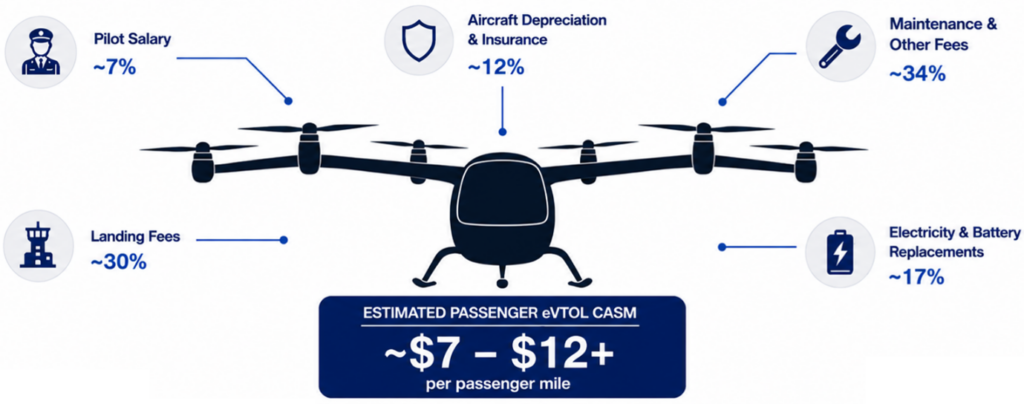
In our recently published report “The Future of Advanced Air Mobility – 2026”, we analysed a range of cost drivers and ultimately found that initial CASM is likely to come in at somewhere between $7-12 per seat mile for a standard 4-seat eVTOL. The remainder of this post looks more deeply at these components and concludes with our view on the ways in which CASM and – ultimately – ticket pricing can be made lower.
Source: Valour Consultancy
As the graphic shows, one of the biggest contributors to CASM is landing fees at around 30% of the estimated total. However, many OEM cost models massively underestimate its impact. In its 2021 investor materials, for example, Joby’s assumptions implied landing fees of just $10.56 per flight. But when you look at where these aircraft will ultimately fly – from legacy infrastructure, at least initially – the reality is markedly different. Battersea London Heliport’s published 2025 tariff runs from £400 for the smallest types to over £2,300 for heavy aircraft. U.S. FBOs, meanwhile, start at around $300 per movement, and European equivalents around €480. At the other extreme, all-in costs at a major hub like Heathrow can reach £8,000 at peak slots.
It’s taken as given that electricity costs less than jet fuel, and real-world operator experience backs this up. One UK Pipistrel Velis Electro operator reports energy costs of around £5 per flight hour against roughly £50 for a comparable piston trainer. But the headline energy figure is not the whole story, and battery replacement is a substantial cost that could entirely erode those savings. In our modelling, electricity and battery replacements together account for around 17% of CASM, with the underlying assumptions largely based on figures disclosed by BETA Technologies: one of their aircraft operated over 20 years could require 18–20 battery replacements, at a cost of ~$0.65m per aircraft per year. BETA’s current focus is eCTOL rather than eVTOL, so that figure is likely conservative as a proxy – vertical operations are more energy-intensive, put greater stress on battery cells, and operators will hope that eVTOL utilisation rates will be higher – all potentially leading to more frequent replacement cycles.
Another notable cost driver is pilot salary, though it is not nearly as consequential as might be implied by those banking on autonomy to create a class of transport affordable to the masses. Industry models frequently assume pilot salaries of around $100,000 per year, but ours uses $150,000 – reflecting expected wage growth by the time services reach scale, the well-documented pilot shortage, and the unique skillset required. Indeed, eVTOL air taxi operations are expected to run frequently under IFR, in congested airspace near major airports, requiring instrument-rated pilots, ideally with experience across both rotary and fixed-wing aircraft. That is a narrow labour pool, and a narrow pool commands a premium – yet even at $150,000 and applying realism to annual flight hours, pilot salary accounts for only around 7% of total CASM.
In the interests of brevity, we’ll not go into detail on other important components of CASM like aircraft depreciation and insurance, or broader operator overheads like maintenance, airspace usage charges, safety and compliance functions, or data and airtime charges associated with onboard connectivity. But lumped together, they account for a sizeable 34% share and our report covers these in depth.
Which brings us to the obvious question: how do you actually bring these costs down? Removing the pilot is the answer many reach for first, but as the numbers show, it doesn’t transform the economics nearly as much as assumed – and you still need maintenance engineers, ground handlers, dispatchers and operational staff regardless of what’s happening in the cockpit. And even in a fully autonomous model like Wisk’s, an onboard crew member would presumably still be required to ensure passenger safety and security, particularly in the event of an emergency landing or evacuation.
Cheaper, longer-lasting batteries would clearly help, as would reducing the upfront cost of the aircraft itself. Depreciating an expensive asset over its useful life is a far heavier burden than doing the same with a cheaper one, which is why EHang’s two-seat EH216-S – priced at $330,000 in its home market but $410,000 elsewhere – produces a CASM far more consistent with the economics the industry originally promised than Archer’s $5m Midnight ever will.
Building purpose-built vertiports where landing fees align with early OEM assumptions is another lever but at the risk of stating the obvious, reshaping urban infrastructure at scale is a far from straightforward endeavour. Somebody has to fund that build-out, and the question of who will invest billions across multiple cities before demand is proven, while navigating regulatory hurdles and societal acceptance issues, remains largely unanswered. Dubai is the exception that proves the rule: government backing has accelerated infrastructure rollout in ways that simply cannot be assumed everywhere.
That leaves seat count as arguably the most realistic lever available. More seats means fixed costs spread across more available seat miles – potentially making the difference between an ‘air limousine’ and something approaching mass-market access. Most Western eVTOL programmes have converged on four-passenger configurations due to the weight, range and payload limitations imposed by current battery technology, but larger platforms are beginning to emerge:
- Vertical Aerospace has proposed a six-seat Valo variant;
- AutoFlight has unveiled the nine-passenger V5000 Sky Dragon;
- Sora Aviation is developing the S-1, a 30-seat “flying bus” targeting high-capacity urban and airport shuttle routes.
Whether these larger platforms go on to prove themselves remains to be seen. But looking at the economics of today’s leading platforms I can’t escape the feeling that like very light jets before them, passenger eVTOLs are destined to begin life as a premium aviation product rather than a mass-market transport revolution. The technology is undoubtedly impressive. The economics, however, remain stubbornly grounded.