Introduction
Ask someone to picture an autonomous vessel, and they will probably imagine a crewless container ship crossing the Pacific with nobody on board, guided entirely by AI. It is an image that captures headlines and fuels conference debates. The reality, however, is considerably less dramatic and considerably more interesting.
History shows that technological revolutions rarely arrive overnight. Britain’s Industrial Revolution did not begin with fully mechanised factories appearing overnight; it advanced through decades of incremental improvements, with each innovation making the next commercially viable. Even Arsenal, founded by munitions workers in the 1880s, took rather longer than one season and several billion pounds to become the finished article.
Maritime autonomy is following much the same path.
Rather than replacing crews in a single leap, shipowners are steadily adopting technologies that solve immediate operational challenges. AI-assisted collision avoidance, intelligent route optimisation, predictive maintenance and automated decision support are already improving safety, reducing workloads and delivering measurable commercial returns, all while experienced crews remain firmly on the bridge.
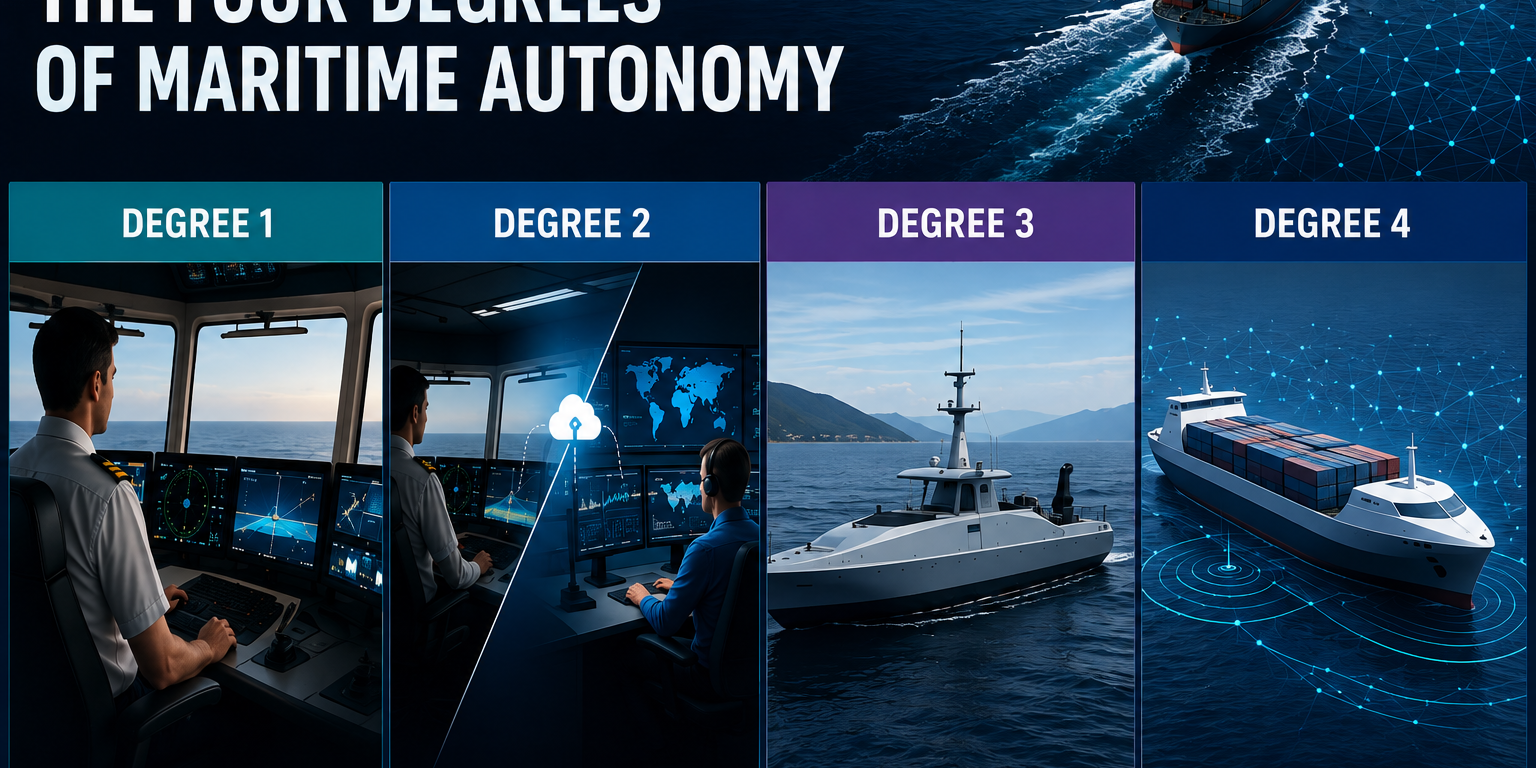
To help define this journey, the maritime industry has established four recognised Degrees of Autonomy, ranging from crew-assisted decision support through to fully autonomous operations. Understanding these four stages is arguably the most important framework for understanding where the market is heading. While headlines continue to focus on the distant prospect of crewless merchant ships, the real story lies in how the industry is progressing, one commercially sensible step at a time.
The Four Degrees Explained
Maritime autonomy is often discussed as though it represents a single destination. In reality, it is a journey comprising four recognised Degrees of Autonomy, each representing a different balance between human expertise and automated decision-making.
Degree 1 is where the vast majority of commercial activity takes place today. Seafarers remain fully responsible for operating the vessel, while autonomous technologies assist with individual tasks such as collision avoidance, navigation support, AI-powered lookout functions, route optimisation and fuel efficiency.
Companies including Orca AI, Avikus and Kongsberg Maritime are helping bridge teams make faster, more informed decisions, improving both safety and operational performance without fundamentally changing how ships are crewed.
Degree 2 builds upon this foundation by introducing remote operational support while crews remain onboard. Certain monitoring and decision support functions can be shared with shore-based Remote Operations Centres, supported by AI analytics, digital twins and fleet-wide monitoring platforms. Rather than replacing seafarers, this approach combines onboard experience with additional expertise ashore, creating an attractive balance between operational efficiency, safety, regulatory acceptance and commercial practicality.
It is this combination that is likely to make Degree 2 the industry’s commercial sweet spot over the coming decade.
Degree 3 represents a far more significant step. Vessels operate without crews onboard but remain under continuous remote control from dedicated operators ashore. While technically achievable for many applications, successful deployment depends upon highly resilient communications, extensive system redundancy and an evolving regulatory framework. As a result, Degree 3 is currently finding its greatest success in defence, offshore energy and other specialist unmanned vessel operations where controlled operating environments reduce many of the associated risks.
Degree 4 is the vision that captures most headlines: vessels capable of making every navigational and operational decision entirely independently. Although technically exciting, widespread commercial deployment remains some distance away. Regulatory approval, insurance liability, cybersecurity, communications resilience and public acceptance all present significant hurdles.
Fully autonomous merchant shipping will undoubtedly arrive, but for most commercial operators the more immediate opportunity lies in progressively advancing through the earlier degrees of autonomy rather than attempting one giant leap.
Why Degree 1 Is Winning Today
There is an old saying in the technology industry that people consistently overestimate what will happen in the short term and underestimate what will happen over the longer term. Maritime autonomy appears to be proving the point.
Much of the industry’s attention continues to focus on Degree 4 autonomy, with visions of fully autonomous merchant vessels crossing the world’s oceans without crews onboard.
Yet the commercial reality looks rather different. Today’s investment is overwhelmingly concentrated in Degree 1 technologies, where autonomous systems support rather than replace experienced seafarers.
The reasons are straightforward. Degree 1 solutions require little regulatory change, integrate with existing bridge operations and can often be retrofitted to vessels already in service.
Shipowners are not being asked to redesign operating models or convince insurers and regulators to accept radically different ways of working. Instead, they are purchasing technologies that improve navigational safety, optimise fuel consumption, reduce crew workload and enhance operational awareness from the very first voyage.
Perhaps the closest comparison comes from the automotive industry. Drivers did not purchase adaptive cruise control or lane keeping assistance because they expected fully autonomous cars the following year. They adopted these technologies because they made driving safer, easier and less stressful.
Maritime autonomy is following much the same trajectory.
Importantly, every successful Degree 1 deployment generates something even more valuable than operational savings. It creates trust. Every collision avoided, every AI recommendation validated and every voyage successfully completed provides shipowners with the confidence and operational data needed to progress towards the next stage of autonomy.
Degree 2: The Commercial Sweet Spot
If Degree 1 represents today’s market, Degree 2 is likely to define tomorrow’s.
Rather than focusing on removing crews, Degree 2 enhances them. Vessels continue to operate with experienced personnel onboard, but increasingly draw upon shore-side expertise through Remote Operations Centres, AI monitoring platforms and digital twins capable of analysing vessel performance in real time. Bridge teams remain firmly in control while gaining access to additional technical support, fleet intelligence and operational decision-making from ashore.
This combination offers perhaps the most attractive balance between technology, regulation and commercial practicality. Shipowners gain greater visibility across their fleets, engineers can diagnose equipment issues remotely before failures occur, and operators can optimise voyages using information gathered from hundreds of vessels simultaneously. The result is improved safety, lower operating costs and reduced pressure on increasingly stretched crews.
As operational confidence grows, some routine activities may gradually migrate ashore, potentially reducing crew requirements on certain vessel types. However, this evolution is likely to be driven by operational efficiency rather than a desire to remove seafarers altogether.
Perhaps the greatest opportunity lies beyond the bridge itself. Fleet intelligence platforms will increasingly enable operators to benchmark vessel performance, monitor safety trends, analyse fuel efficiency and support fleet-wide decision-making from a central location. At the same time, cybersecurity becomes inseparable from autonomy. Every additional connected sensor, remote operator and cloud platform expands the digital attack surface, making resilient communications and secure infrastructure as important as the autonomous software itself.
Ultimately, Degree 2 succeeds because it builds upon the trust established through Degree 1 rather than attempting to replace it.
Degree 3: When the Crew Goes Ashore
Degree 3 represents the point at which crews leave the vessel, but humans do not leave the operation. Instead, vessels are controlled and supervised remotely from dedicated shore-side operations centres, with operators able to intervene whenever necessary. The technology required for this is advancing rapidly, but success depends upon far more than autonomous navigation alone.
Reliable satellite communications, resilient onboard systems, cybersecurity and multiple layers of redundancy become mission critical. If communications are interrupted, vessels must be capable of maintaining safe operations until contact is restored. Regulatory frameworks must also evolve to determine liability, certification and operational procedures for remotely operated vessels.
For these reasons, Degree 3 is finding its greatest success in specialist applications rather than deep sea merchant shipping. Defence, offshore energy, hydrographic surveying, environmental monitoring and harbour operations all offer controlled environments where the commercial benefits of removing crews often outweigh the operational challenges. In many respects, these sectors are becoming the proving ground for technologies that may eventually migrate into commercial shipping. Uncrewed surface vessels are already providing a live commercial laboratory for this model. In survey, offshore energy, defence and environmental missions, removing onboard crews can reduce vessel size, accommodation requirements and operating costs, while shore based teams supervise multiple assets. In effect, USVs are demonstrating that Degree 3 can create commercial value today, even if crewless deep sea merchant shipping remains a more distant proposition.
Degree 4: The Final Frontier
Degree 4 is the vision that captures headlines: vessels capable of making every navigational and operational decision entirely independently, without onboard crews or continuous human supervision. It represents the highest level of maritime autonomy and remains the aspiration for many technology developers.
Yet achieving this vision involves overcoming far more than technical challenges. International regulations, insurance frameworks, cybersecurity, communications resilience and public confidence must all evolve alongside the technology itself. Even if autonomous systems become technically capable of replacing human decision making, shipowners, insurers, regulators and cargo owners must also develop sufficient confidence to entrust vessels operating in complex global shipping lanes.
History suggests that widespread adoption will occur gradually rather than suddenly. Just as commercial aviation still relies upon highly trained pilots despite increasingly sophisticated automation, merchant shipping is likely to continue blending human expertise with intelligent systems for many years. Fully autonomous vessels will undoubtedly become part of the maritime landscape, but they are more likely to represent the culmination of decades of incremental progress than a sudden technological revolution. The question, therefore, is not whether Degree 4 will eventually become technically possible. In many respects, it already is. The more important question is when the regulatory, insurance and commercial environment makes removing the final human from the operational loop economically worthwhile. That transition may take considerably longer than the technology itself.
So, Where Is the Commercial Opportunity?
The answer depends on where organisations sit within the maritime ecosystem.
Technology vendors should focus less on developing isolated features and more on building integrated ecosystems. Shipowners increasingly value platforms that combine autonomous navigation, connectivity, fleet intelligence, cybersecurity and voyage optimisation rather than standalone applications.
Shipowners should resist the temptation to view autonomy as an all-or-nothing decision. Degree 1 deployments offer immediate operational benefits while allowing organisations to build the experience, data and confidence that will underpin future adoption of Degree 2 capabilities.
Satellite operators and communications providers occupy an equally important position. Autonomous operations depend upon reliable, resilient and increasingly low-latency communications. As remote operations expand, network availability and cybersecurity will become as commercially important as bandwidth itself.
For investors, perhaps the most interesting question is no longer, “Who will build autonomous ships?” A better question may be, “Who profits every time autonomy increases by one degree?” The long-term winners are likely to be the companies enabling every stage of the journey, from AI software and connectivity through to fleet intelligence, cybersecurity and remote operational support.
Conclusion
Maritime autonomy is not one giant leap into a crewless future. It is thousands of incremental improvements that gradually reshape how vessels are operated.
History suggests that industries rarely transform overnight. Instead, they evolve through commercially sensible decisions that steadily build confidence, capability and trust. That is precisely what appears to be happening across the maritime sector today. Degree 1 is already delivering measurable operational and financial value, while Degree 2 is emerging as the industry’s most compelling balance between technology, regulation and commercial practicality. Meanwhile, USVs continue to demonstrate that autonomous operations can generate meaningful revenues today rather than at some point in the distant future.
Degree 4 will undoubtedly arrive, but perhaps later than many of the industry’s boldest predictions suggest. Ultimately, the companies that create the greatest long-term value will not necessarily be those pursuing the most futuristic vision. They will be the organisations that help shipowners take the next practical step, converting operational trust into scalable commercial adoption, one degree at a time.
If you are interested in purchasing a copy, please click here to access our report brochure, which includes: please click here
- Introduction to the report
- Key questions answered
- TOC
- Report scope
- Sample Pages
- How to access the report