To say Starlink increased its connectivity prices in business aviation is an understatement. Starlink, without any warning, doubled the cost of connectivity to all business aviation users, new and old, effective immediately. What does this mean for the market as we know it today?
When Starlink entered the market in 2022, it was more than just another IFC service. With low latency, high speeds, and a small form factor electronically-steered antenna (ESA) that could fit on almost any jet, the solution had the power to fundamentally change IFC. Business jet connectivity was finally achieving parity with wi-fi on the ground, which was exactly what the market had been waiting for.
However, Starlink saw relatively slow growth initially, reaching only 80 aircraft across all of aviation in its first year. While other factors were likely at play, for example its focus on large commercial aviation fleets and lack of Supplemental Type Certificates (STC), a possible early perturbant was the initial monthly price tag – $25,000 for global unlimited and $12,500 for regional unlimited.
In 2024, the firm slashed its prices to $10,000 unlimited and $2,000 for 20GB per month anywhere in the world, seriously undercutting incumbents with higher-latency solutions. In retrospect, it may have been an offer too good to be true! As a result of the price drop and the firm’s expanding dealership network, Starlink grew exponentially from here. According to the company’s latest progress report, its business aviation installed base reached over 1,000 in 2025 with over 800 of those installations taking place that same year. Starlink was rapidly establishing itself as the dominant retrofit solution and was even making progress in the line-fit market.
That momentum has now encountered its first major test with this latest price hike.
Figure 1. Starlink’s Business Aviation Pricing
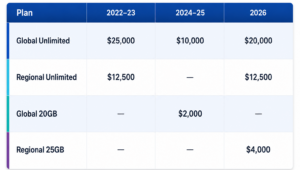
Source: Valour Consultancy
Was The Slash Always Temporary?
Looking back, Starlink’s reduced pricing appears exceptionally aggressive. There were certainly murmurs at industry events suspecting a price increase would happen. People were surprised when 2025, then 2026, came around and it hadn’t. The apparent price stability and excellent service, in a market where aircraft operators had grown accustomed to premium prices for subpar performance, accelerated adoption of the solution to numbers not seen before.
It’s worth pointing out the parallels with Tesla in the electric car market. After all, Musk has stated that he cares more about sales growth over profit margins so the price slash for Tesla in 2023 wasn’t a surprising market strategy. And it worked – vehicle sales reached a record high of 1.8 million in 2023, though the firm’s profit margins were fairly thin. Since then, Tesla has adopted a more dynamic pricing strategy, with prices rising or falling depending on factors such as demand, inventory levels, competition and production costs. While some models have become more expensive again, the increases have generally been incremental rather than anything like a doubling in price.
Why? There wasn’t an IPO then. As SpaceX moves closer to a going public, there is increasing pressure to demonstrate stronger recurring revenues, which some have speculated will be achieved via it’s highly sought after Starlink service. Indeed, the firm’s connectivity services accounted for 61% of 2025 revenues. What better market to generate even more revenue from than the affluent that have just spent $300,000 installing the accompanying hardware? Their hands are effectively tied.
But at what cost?
This price hike isn’t the friendliest signal to potential new customers, which may imply movement towards a new phase in which the company is focussed on maximising revenue from existing customers over rapid market expansion.
The impact of the price increase will vary considerably between customers. For example, among charter operators with smaller aircraft and lower utilisation, it could substantially harm profitability. For others, with larger budgets and larger aircraft, this probably isn’t anything to panic over. It’s nothing materially far from what has been paid historically. Moreover, the difference in price is only a fraction of the cost of operating a larger business jet. And if the service is as superior as the feedback suggests, then perhaps it’s worth paying for.
However, there is another option on the market now, Gogo’s OneWeb-powered Galileo. Amazon‘s entry is also on the horizon while Telesat will follow shortly after. Will the price increase cause customers to shift towards alternatives?
In the short-term, Gogo has the opportunity to snap up more of the market for LEO IFC. Looking further ahead, by the time Amazon comes to the party, we expect entirely different pricing altogether. With the depth of both Musk’s and Bezos’ pockets, it’s possible both will heavily undercut each other, and the rest of the market, in order to retain/win market share, which means we may see pricing similar to 2024’s slash in the future.
Looking Ahead
One concern shared by many is the price of maintaining LEO mega-constellations. SpaceX has filed an application with the Federal Communications Commission for authorisation of up to 100,000 satellites, with the first batch scheduled to launch in H2 2026. The cost of replenishing thousands of satellites after just five years of life will require significant revenue, perhaps more than can ever be generated from pricing plans ranging $2,000-$10,000. Which begs the question: Has SpaceX been subsidising Starlink? If so, by how much? At what price point would Starlink break even? Will customers be willing to pay that amount? How will this differ between Starlink and other LEO networks like OneWeb and Amazon?
In our latest report, The Market for IFC in Business Aviation – 2026, we jump off the fence to provide a detailed analysis of where we believe the market is going. Useful for anyone wanting to know where to invest, the report is due to publish in full at the end of July 2026. For a fresh and timely overview of the market, click here to get in touch.

Summer Staninski, Author