Introduction
When Hapag-Lloyd announced that it would deploy Inmarsat’s NexusWave across its fleet earlier this month, most headlines focused on another connectivity contract. They missed the bigger story.
The announcement represents a significant win for Inmarsat and perhaps an even more important signal for the wider maritime connectivity market. After more than 21 months of evaluation, one of the world’s largest container shipping companies selected an integrated managed platform rather than assembling its own combination of Starlink, Eutelsat OneWeb, GEO VSAT and L-band services.
That decision tells us where the next competitive battleground in maritime connectivity is likely to be fought.
Backstory
Historically, Hapag-Lloyd has sourced connectivity from both Inmarsat and Marlink, with different providers serving different parts of its fleet before consolidating around Inmarsat. Even before Starlink entered maritime, Valour Consultancy estimates most vessels operated with burst rates of around 2 Mbps. More importantly, Hapag-Lloyd has consistently treated connectivity as part of a broader digital strategy, investing in crew welfare, endpoint security, email, automated asset management and network monitoring.
Twenty-One Months of Testing
Perhaps the most fascinating aspect of the announcement is the length of Hapag-Lloyd’s evaluation process.
The shipping company began evaluating NexusWave in late 2024 as part of its broader digitalisation roadmap and Strategy 2030 ambitions, leading to trial installations aboard selected vessels.
We are now in the middle of 2026, meaning the testing and evaluation process potentially lasted more than 21 months. That is a considerable period and highlights the level of scrutiny that Hapag-Lloyd appears to have applied before committing its entire fleet to the service.
It is reasonable to assume that Hapag-Lloyd would have been well aware of the alternative connectivity architectures available in the market. These could include combinations of Starlink with GEO VSAT and L band backup, as well as Eutelsat OneWeb integrated with another maritime ISP’s GEO VSAT and MSS services.
The key takeaway from Hapag-Lloyd’s CIO and CHRO was clear:
“NexusWave provides us with a secure, resilient and scalable platform that supports our long-term digitalisation ambitions while improving the onboard experience for our crews.”
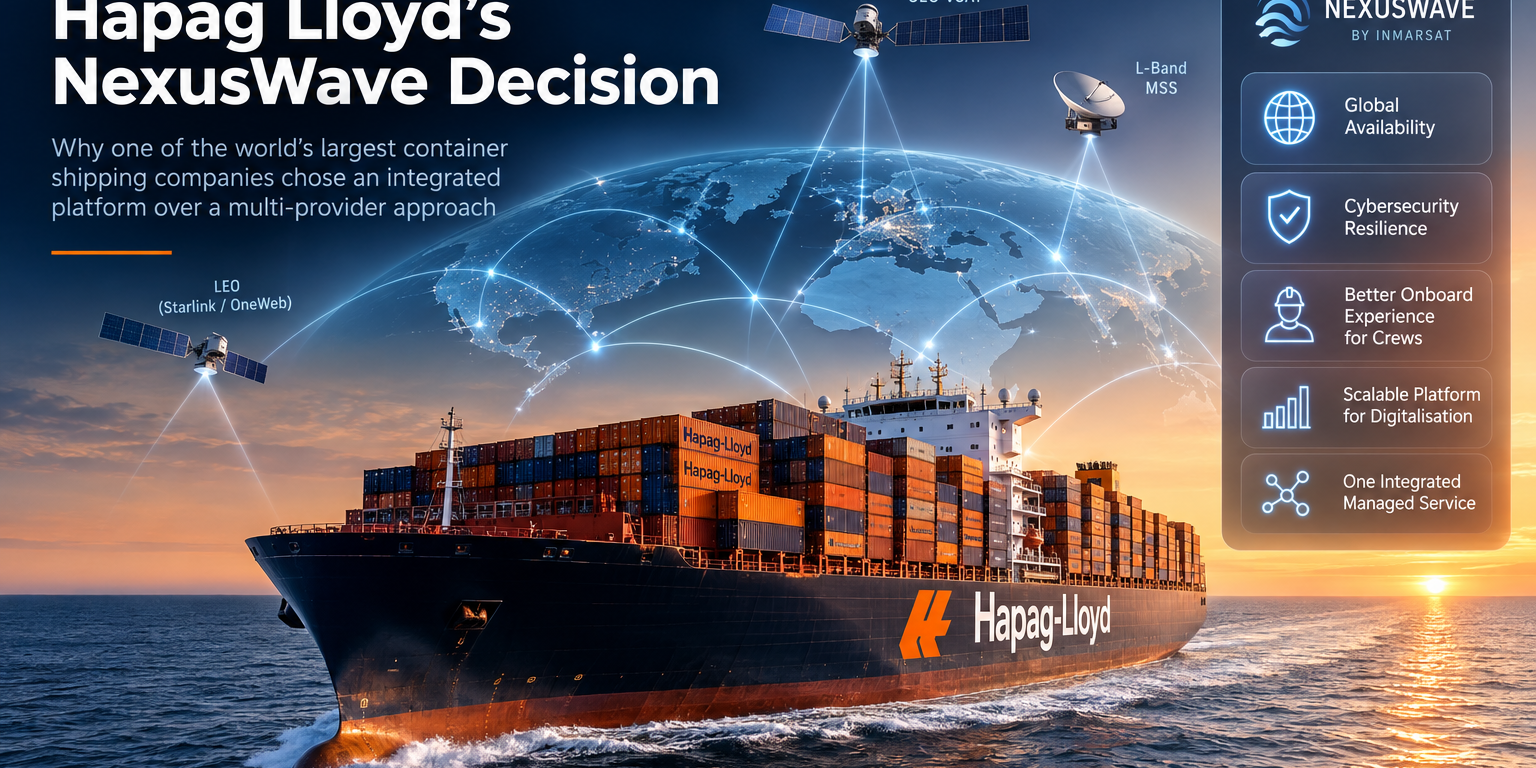
Hapag-Lloyd highlighted global availability, operational continuity, cybersecurity resilience and improved application performance. The key word, however, is platform. The shipping operator appears to have selected NexusWave not simply as another connectivity service, but as the digital foundation for its wider fleet strategy.
Implications: More Than a Battle of Megabits and Monthly Fees
At first glance, Hapag-Lloyd’s decision may appear to be just another fleet connectivity contract. In reality, it highlights a broader shift in how major shipping companies are evaluating maritime communications. The debate is moving beyond bandwidth and headline subscription costs towards total cost of ownership, operational resilience and the ability to deliver a single, globally managed digital platform.
The first is that price remains important, but comparing headline monthly subscription fees alone can be misleading.
Commercial fleets today generally have four broad satellite connectivity architecture options.
The simplest combines Starlink with an L-band backup, offering high bandwidth at relatively low cost, but with the operator responsible for integrating multiple services.
A second approach pairs Starlink with a traditional GEO VSAT service and MSS, improving resilience and global coverage through a hybrid architecture.
A third substitutes Eutelsat OneWeb for Starlink while retaining GEO VSAT and MSS, creating a similar multi-network solution with different coverage and commercial characteristics.
Finally, NexusWave combines multiple connectivity technologies into a single bonded, fully managed platform, with one supplier responsible for network integration, service management and operational continuity.
At face value, a direct Starlink package may appear considerably cheaper. But that is not necessarily a like for like comparison.
The commercial calculation extends beyond the raw cost of bandwidth. Hardware expenditure, installation, backup connectivity, network management, cybersecurity, service support, application performance and the internal resources required to manage multiple providers all contribute to the real total cost of ownership.
Each additional network, terminal, contract and service layer introduces further complexity.
NexusWave’s proposition is fundamentally different to the alternatives. Multiple connectivity technologies are brought together under a single bonded network fully managed service. The customer receives one commercial relationship, one service platform and, importantly for a large global fleet operator, greater consistency across vessels and regions.
China Regulatory Reality
One of the least discussed advantages of hybrid connectivity is regulatory compliance.
Hapag-Lloyd operates one of the world’s largest liner networks, connecting more than 600 ports through 133 liner services, including extensive operations throughout China. The company has maintained a presence in China since 1995 and regularly serves major ports including Shanghai, Ningbo, Qingdao, Yantian and Nansha.
Authorities in China have recently increased checks on LEO regulatory compliance for vessels operating within Chinese territory, as Starlink and other LEO are not authorised for commercial operation in mainland China. To support its customers and help ensure smooth operations, Inmarsat has introduced a LEO geo-fencing agent which helps customers comply with LEO regulations and blocks LEO traffic within 12 nautical miles. However, due to NexusWave’s network bonding architecture which combines GEO, LEO, L-band and terrestrial connectivity, traffic will transition between available networks as vessels move between different jurisdictions, without interrupting connectivity.
For a global liner operator, this matters. Connectivity gaps are not simply an inconvenience; they can affect vessels operating on established commercial routes. Maintaining a consistent managed service across every region may therefore be considerably more valuable than achieving the highest bandwidth in only part of the world.
The Cost of Connectivity… or the Cost of Failure?
The industry is asking the wrong question. The debate has focused on monthly subscription costs rather than the commercial cost of degraded connectivity.
How much does a day of degraded connectivity cost one of the world’s largest container shipping companies?
Against billions of dollars of cargo and complex global operations, the difference between a $1,500 connectivity package and a fully managed platform at a slightly higher price point may quickly become insignificant if the latter delivers greater resilience, security, consistency and operational simplicity.
Hapag-Lloyd may not have been buying more bandwidth. It may have been buying resilience. Anyone who has ever tried to explain to an IT department why four different suppliers are all blaming each other will appreciate the value of simplicity.
A Message for Starlink and the Maritime ISPs
Starlink has fundamentally reshaped maritime connectivity through high throughput, attractive pricing and rapid deployment. Yet Hapag-Lloyd’s decision demonstrates that, for the largest fleets, connectivity is increasingly judged on integration and experience rather than bandwidth alone.
The competitive question is evolving from “Which network is fastest?” to “Who can reliably integrate multiple networks into one managed service?”
There is an important lesson here for Starlink.
That shift also benefits Eutelsat OneWeb, whose LEO capacity forms part of the NexusWave architecture. It also raises an interesting question: how much of OneWeb’s future maritime growth will come through managed hybrid platforms such as NexusWave rather than standalone deployments?
The market is increasingly divided between providers selling individual networks and those selling fully managed digital infrastructure. As connectivity becomes intertwined with cybersecurity, cloud applications, remote support, vessel IT and operational systems, the ability to integrate and manage the entire technology stack may become just as important as the underlying satellite capacity.
Hapag-Lloyd’s decision suggests that there remains considerable value in removing complexity for the customer.
In a market obsessed with ever higher speeds, sometimes the most valuable product is simply making everything work together and enabling connectivity experience we are used to at offices or home.
From Inmarsat’s perspective, the contract validates the company’s strategy of competing on integration and experience rather than pure bandwidth. Starlink has changed customer expectations around speed and pricing, but NexusWave demonstrates there remains a sizeable market willing to pay a premium for simplicity, resilience and globally managed operations.
The objective is no longer simply to sell satellite capacity. It is to become the operating system sitting above multiple connectivity networks.
Conclusions: Horses for Courses, but Integration Matters
The Hapag-Lloyd decision does not mean that NexusWave is automatically the right connectivity solution for every shipowner. Far from it.
A smaller fleet operating primarily within Starlink coverage may find that a direct LEO service, supplemented by an L-band backup, meets its requirements perfectly well and at a lower cost.
But Hapag-Lloyd is not a small regional operator. It manages a large global fleet, operates across regions where connectivity availability and regulatory conditions vary, and has taken a notably holistic approach to onboard IT, cybersecurity, crew connectivity and digitalisation.
For such an operator, consistency and simplicity have considerable value.
Three conclusions stand out.
- First, price matters, but total cost of ownership and operational complexity matter more. The cheapest satellite subscription is not necessarily the cheapest connectivity architecture once equipment, backup services, cybersecurity, network management, support and internal resources are taken into account.
- Second, hybrid connectivity is becoming the default architecture for major commercial fleets. The debate is increasingly shifting away from GEO versus LEO towards how GEO, LEO, MSS and terrestrial connectivity can be intelligently combined. The competitive battleground is shifting from individual satellite networks to the orchestration layer above them.
- Third, the lengthy evaluation period makes Hapag-Lloyd’s decision particularly significant. After potentially more than 21 months of evaluation and testing, the shipping company has committed its fleet to NexusWave. That is a meaningful endorsement not simply of the underlying satellite capacity, but of the managed service model itself.
There is also a broader strategic question for Inmarsat. NexusWave is central to its efforts to defend and evolve its position in maritime connectivity as Starlink continues its rapid expansion and Eutelsat OneWeb builds its own presence at sea.
Major fleet wins such as Hapag-Lloyd provide evidence that there remains strong demand for premium, fully managed hybrid connectivity, particularly among operators that view communications as business-critical infrastructure rather than merely a pipe to the internet.
And finally, there is a future-proof vision.
One fleet win rarely changes a market. Winning one of the world’s largest container fleets certainly gets people’s attention.
As Inmarsat continues its push to expand the NexusWave installed base and adding new capacity with the upcoming ultra-high-capacity ViaSat-3 network, Hapag-Lloyd represents precisely the type of major fleet commitment that can rapidly move the needle. The contract is not only important because of the number of vessels involved; it also provides a high-profile reference customer for other large shipping companies considering their own next generation connectivity strategies.
Thus, this may be the most important takeaway from Hapag-Lloyd’s decision.
Maritime connectivity is no longer simply about connecting a vessel. It is about connecting an increasingly complex digital ecosystem of crew, applications, operational systems, cloud platforms and cybersecurity tools.
The Hapag-Lloyd announcement suggests something much bigger than another fleet connectivity contract. It demonstrates how the commercial conversation is evolving. Maritime connectivity is no longer judged solely on megabits per second or the monthly subscription fee. Increasingly, it is being judged on resilience, simplicity, cybersecurity, regulatory compliance and the ability to support an increasingly digital fleet.
For the largest global shipping companies, connectivity has become critical infrastructure rather than simply another onboard utility.
The fastest connection will not always win. In maritime connectivity, bandwidth wins headlines. Simplicity wins fleets.
To learn more about key market players across the maritime connectivity industry, including a deep dive into the competitive environment and corresponding market shares, please request a copy of our report on The Future of Maritime Connectivity.
Our report portfolio offers a wealth of market insight across maritime digitalisation, as well as maritime cybersecurity. For our latest reports in this space and to download free sample pages, please click here.