A Future Automated Port

That’s an Offload on My Mind

Introduction Much of the discussion surrounding automated and smart shipping focuses on navigation, propulsion, remote operations and artificial intelligence. Yet one of the industry’s biggest opportunities to improve safety, efficiency and profitability lies somewhere far less glamorous: cargo handling. For many commercial applications, automated shipping is perhaps the more appropriate term than autonomous shipping. While…

Digital Ship

From Maritime IT Specialist to Digital Swiss Army Knife: MarPoint’s Reinvention for the Connected Shipping Era

Introduction One of the beauties of our work as market intelligence analysts is the opportunity to interview fascinating people and companies. Better still is speaking to the same companies over many years and seeing how their businesses evolve as technology, competition, and customer requirements change. In the autumn of 2022, Valour Consultancy interviewed MarPoint, then…

Key Headlines from Valour Consultancy’s Q1 2026 Maritime Connectivity Market Tracker Update

We’re delighted to announce the arrival of our Q1 2026  Maritime Connectivity Market Tracker data instalment, featuring new insights on Starlink Maritime deployments and revenues, Inmarsat Nexus and OneWeb’s activations, offshore energy sub-segments, and annualised revenues per service provider. This service complements our flagship report, “The Future of Maritime Connectivity” offering a granular deep dive into installation…

PRESS RELEASE: PLANES, VEHICLES & VESSELS EMBRACE LEO CONNECTIVITY WITH FLAT PANEL ANTENNA SHIPMENTS PROJECTED TO REACH HALF A MILLION BY 2035

London, April 15th, 2026, 11:00 British Summer Time (BST)  Flat panel antennas are moving firmly into the mainstream, with shipments across aviation, land mobility and maritime projected to approach half a million units by 2035, according to Valour Consultancy’s new report titled ‘The Future of Flat Panel Antennas – 2026’.      The company’s previous analysis, published in 2023, projected flat panel shipments to reach…

Key Headlines from Valour Consultancy’s Report on The Future of Autonomous Maritime Vessels – 2026 Edition (Preliminary Data)

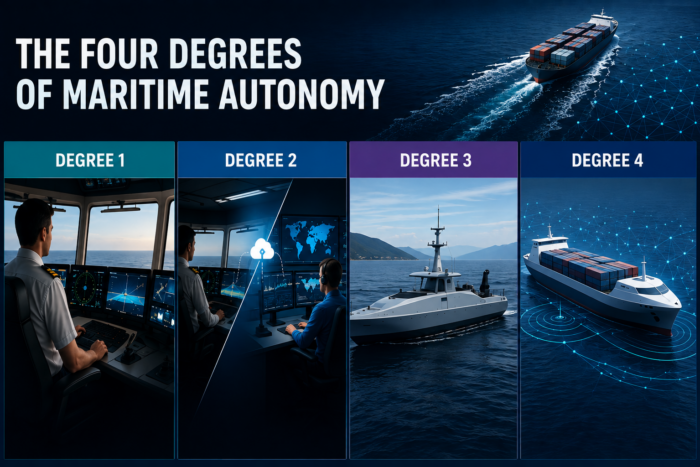
With Valour Consultancy’s Future of Autonomous Maritime Vessels – 2026 Edition nearing release, preliminary findings have been shared with early purchasers and programme participants. The updated data provides valuable insight into the evolving maritime autonomy landscape.  The study examines vessel volumes across the International Maritime Organization’s IMO four degrees of autonomy, alongside key enabling subsystems. Valour Consultancy categorises autonomous maritime technologies…

Dead Ringers

INTRODUCTION Artificial Intelligence (AI) is a tool using Data Enhanced Algorithmically Developed (DEAD) computing. The original algorithms are developed by humans and, if sufficiently sophisticated, they can allow an AI program to develop further algorithms (a set of instructions to be followed in calculations or other operations) based on vast data arrays made available to…

Amazon Leo & Starlink: Q1 2026 Maritime Market Update on LEO VSAT Services

Latest News of Amazon Leo Amazon’s LEO programme has been known to the market for years as “Project Kuiper”. That era is over. In November 2025, Amazon formally rebranded the initiative as Amazon Leo, framing it as a shift from development milestones towards commercial operations and, crucially, enterprise contracting. The rebrand wasn’t just a “badge…

Press Release: Commercial Revenue for Maritime Connectivity Services Worth $2.4 billion in 2024

JANUARY 14TH, 2026, 11:00 Greenwich Mean Time (GMT) Valour Consultancy is pleased to announce its latest report: ‘The Future of Maritime Connectivity – 2025’. Its latest study on the global commercial maritime satellite connectivity market highlights a sector entering a new capacity and bandwidth paradigm. The maritime connectivity industry is undergoing a period of structural…

MEMS The Word

Introduction Following our article on quantum gravity navigation last summer, it is appropriate to discuss Micro-Electro-Mechanical Systems (MEMS) Inertial Navigation Systems (INS). These are quite wonderful devices that use microscopic inertial sensors such as accelerometers, gyroscopes and magnetic field sensors to provide orientation, heading and velocity data, particularly valuable in applications requiring continuous navigation in…