The commercial drone industry is entering an interesting phase. Having spent years demonstrating what unmanned aircraft can do, attention is increasingly turning towards how these capabilities can be deployed at scale. From emergency response and critical infrastructure inspection to last-mile delivery, the opportunities are expanding. However, regulatory frameworks, airspace integration and reliable connectivity remain critical challenges.
These themes were evident at DroneX 2026, held at London’s ExCeL Centre in September, where Valour’s resident advanced air mobility (AAM) and drone experts, Craig Foster and Summer Staninski, joined an increasingly busy mix of manufacturers, operators, connectivity providers and regulators.
While defence applications continue to command significant attention and investment, not least as a result of the Russia-Ukraine conflict, the growing commercial presence was particularly encouraging. Drones are becoming embedded in day-to-day operations across a growing range of industries. The question is increasingly shifting from whether fleets will scale to when, and what needs to happen to make that possible.
This transition is reflected in Valour’s latest research, The Future of Advanced Air Mobility – 2026 and The Future of Commercial Drones – 2026, which explore future fleet growth, commercial opportunities and the challenges facing these emerging markets. Our research points towards significant growth in drone and AAM fleets over the coming decades, creating opportunities for technology developers, infrastructure providers and, importantly, the companies responsible for keeping these aircraft connected.
So, beyond the bigger crowds and impressive hardware, what stood out? Here are our six key takeaways from the show.
- A bigger show, and a commercial market finding its feet
First things first, DroneX was noticeably busier than last year. There was even a ten-minute queue to get in, while the speaking sessions were packed. Unfortunately, with audio available only through headphones for seated attendees, those left standing couldn’t hear much of what was being discussed. It seems even the organisers weren’t quite expecting the turnout!
More importantly, the mix of exhibitors felt different. Defence remains a major driver of investment and innovation, but commercial applications appeared much more prominent this year.
That’s encouraging, particularly as drones are increasingly moving beyond demonstrations and trials into practical applications across law enforcement, emergency services, inspection and delivery. The technology has already proven its worth in many of these areas. The bigger challenge now is creating the conditions for widespread, commercially sustainable deployment.
- BVLOS: The key to unlocking commercial scale
Beyond visual line of sight (BVLOS) operations were a recurring theme across the conference programme, and for good reason.
While drones operating within visual range are useful for numerous applications, the real benefits of activities such as long-distance infrastructure inspection and last-mile delivery depend on aircraft being able to operate safely over much greater distances, without a pilot maintaining direct visual contact.
The discussions highlighted the importance of collaboration between regulators, operators, airspace management specialists and connectivity providers. Legislation needs to evolve, but so too does the supporting infrastructure.
There’s little point developing drones capable of flying hundreds of kilometres if the regulatory and operational environment restricts them to a fraction of that potential. Moving from occasional BVLOS approvals towards routine operations will be a major determinant of how quickly the commercial market develops.
- Cellular connectivity needs a more coordinated approach
It was encouraging to see BT represented alongside Ofcom, the UK Civil Aviation Authority (CAA) and the Department for Transport (DfT). Their presence underlined just how important connectivity is becoming to the future of commercial drone operations.
For smaller aircraft operating over land, cellular is often viewed as the most cost-effective connectivity option. Existing network infrastructure offers obvious advantages, but supporting potentially large numbers of connected aircraft presents a different set of requirements from conventional terrestrial users.
At the show, the GSMA stressed the urgency of developing a more standardised approach among mobile network operators (MNOs). Requirements extend from electronic conspicuity and tracking to the transmission of live video and other mission-specific data, with reliability and security critical throughout.
For MNOs, this represents an attractive emerging market, particularly given the scale of future fleet growth anticipated in Valour’s research. However, commercial success will require more than simply extending existing mobile services into the sky. Operators will need solutions designed around the operational, safety and regulatory requirements of unmanned aviation, ideally with sufficient standardisation to support operations across different networks and national borders.
- Starlink is everywhere – but is it always the right answer?
It probably won’t surprise anyone that Starlink featured prominently in discussions around satellite connectivity. Its relatively low cost, high performance and ease of installation have made it an attractive option across numerous mobility markets, and drones are no exception.
Indeed, there seems to be an overwhelming desire to put Starlink on anything that flies at the moment. Brand power in action!
However, enthusiasm shouldn’t obscure some important limitations.
For example, Starlink’s published guidance restricts external aircraft mounting of its Mini antenna, raising questions about the suitability of certain installations. Geographic coverage and regulatory approvals also remain considerations, particularly for operations involving markets such as China and India.
Interestingly, these limitations haven’t prevented airlines including VietJet, Korean Air and Asiana from pursuing Starlink installations, despite the complexities associated with some of their routes.
Of course, commercial drones and passenger aircraft have very different operational requirements. What works well for one application won’t necessarily be appropriate for another, particularly where size, weight, power consumption and assured connectivity are critical.
The takeaway? Starlink is undoubtedly an important player, but the drone market is unlikely to be a winner-takes-all opportunity.
Figure 1: BRINC Guardian public safety drone with Starlink connectivity (left) and Insitu Integrator UAS with Gogo Galileo HDX (right).
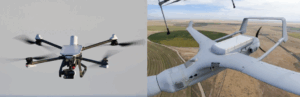
Source: BRINC, Gogo
- Resilience and sovereignty could create opportunities for Starlink’s rivals
Beyond technical performance, another important consideration is the degree of control that operators and governments have over their communications infrastructure.
For critical public-safety and defence missions, relying on a privately owned satellite network can introduce concerns around service availability, access prioritisation and operational sovereignty. High bandwidth and low latency are valuable, but they’re not necessarily the most important requirements when communications must remain available under challenging circumstances.
This could create opportunities for alternative LEO providers and established satellite operators.
In September, Boeing’s Insitu and Gogo successfully tested connectivity on a military drone using a modified Hughes HDX antenna connected to the Eutelsat OneWeb network. Meanwhile, Amazon Leo’s compact Nano antenna could potentially open opportunities in the unmanned aircraft market, particularly for communications-on-the-move applications.
As Starlink establishes a strong position across larger aviation markets, it will be interesting to see whether competitors increasingly target the growing UAV sector.
Established providers such as Viasat and Iridium also have an important role to play. Their L-band capabilities remain particularly relevant where assured communications, coverage and resilience take priority over high throughput. Ultimately, we expect different operational requirements to support a mix of connectivity technologies rather than a single dominant solution.
Sovereign satellite networks add another dimension. Governments are increasingly examining how much control they require over critical communications, from infrastructure ownership and network operations to data governance and service prioritisation. This doesn’t necessarily mean every country needs to build and operate its own satellite constellation, but it does raise important questions about dependence on foreign-owned infrastructure.
These issues are explored in Valour’s new report, Sovereign Connectivity: An Assessment of Current Capabilities and Future Demand – 2026, which examines how governments are approaching network sovereignty, the capabilities available to them and the opportunities emerging for satellite and infrastructure providers.
For the drone industry, the implications are particularly interesting. As unmanned aircraft become more important to public safety, defence and critical infrastructure operations, decisions about connectivity may increasingly be shaped by national security and resilience considerations, rather than cost and performance alone.
- Public acceptance: Purpose matters
One final theme worth highlighting is public acceptance.
Let’s face it, not everyone is thrilled by the prospect of drones flying overhead, particularly if their main purpose is delivering someone’s takeaway a few minutes faster.
However, perceptions can change considerably when the benefits are more tangible.
Drones delivering medical supplies to remote communities, supporting search-and-rescue operations or inspecting dangerous infrastructure present a much more compelling proposition. In these situations, the technology can save lives, reduce risks to emergency personnel and improve access to essential services.
We expect these applications to remain important drivers of commercial adoption, not only because the operational benefits are clear, but because they help build public confidence in the technology.
The industry still has work to do in addressing concerns around privacy, noise and safety. Nevertheless, demonstrating genuine societal and operational value will go a long way towards improving acceptance and creating the conditions for wider deployment.
From possibility to practicality
If DroneX 2026 demonstrated anything, it’s that the commercial drone industry is increasingly moving beyond the experimental stage. The technology is advancing, applications are expanding and commercial interest is clearly growing.
But scaling up is about much more than building better aircraft. Regulatory frameworks, airspace integration, reliable connectivity and public acceptance all need to develop alongside the technology.
For connectivity providers in particular, this represents a significant opportunity, but one where different applications will demand different solutions. Cellular networks, commercial satellite constellations, resilient L-band services and sovereign connectivity capabilities all have potential roles to play.
It was great to catch up with familiar faces and meet so many people doing genuinely interesting things at DroneX. We’ll be continuing to explore these developments through our research into AAM, commercial drones and satellite connectivity over the coming months.
If you’d like to learn more about our findings, discuss where we see the market heading or explore how our research and consultancy services could support your business, please get in touch.