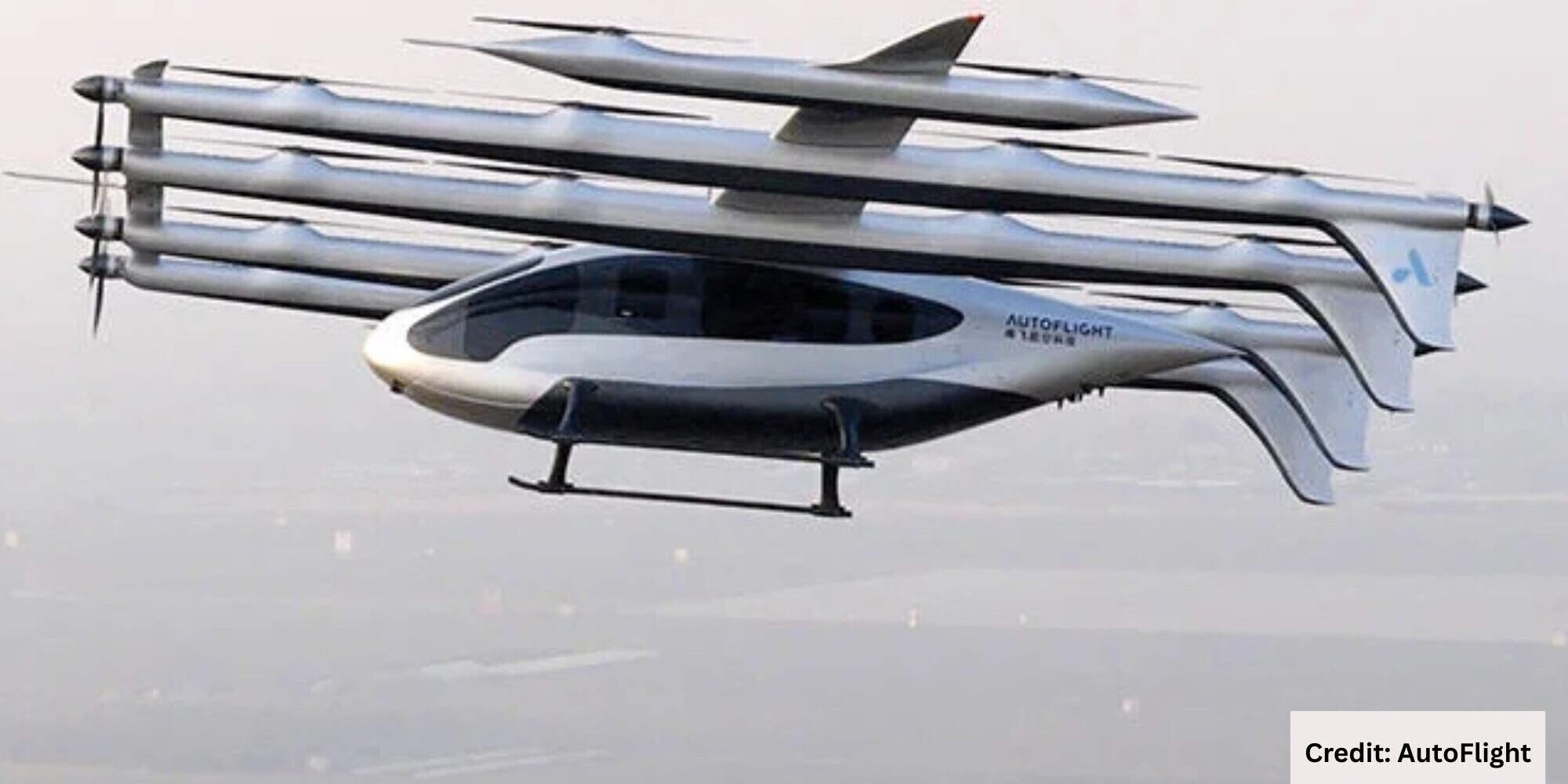
Upon checking out the footage from the recent demonstration of AutoFlight’s new V5000 Matrix eVTOL, I felt compelled to write something about the noise signature of these aircraft. Why? Well we’re repeatedly told that they’re ostensibly quiet and that this will lead to their proliferation throughout our cities. But is the sound they make a significant factor when it comes to adoption?
Check out exhibit A. And when you’ve done that, have a look at exhibit B. Now to AutoFlight’s credit, and in contrast to some of the other OEMs out there, they’ve not relied solely on slick promotional videos with dramatic background music obscuring the sound of their aircraft. Instead, they’ve conducted public demonstrations, allowing attendees to share what they see and hear. Thanks to this, we’re left in no doubt about the tonal whines emanating from the plethora of propulsors that adorn the fuselage as these aircraft take to the skies.
So eVTOLs are evidently not quiet, but the way their noise has been framed is very clever, and very deliberate. Indeed, we’re told that they compare favourably to helicopters and will be barely perceptible against the ambient environment of cities, something widely seen as key to their adoption. And I don’t doubt this will play some part. Indeed, New York’s Stop The Chop movement was formed specifically to reduce helicopter noise and is on record as saying it is optimistic about eVTOLs, urging their development to be fast-tracked. That being said, it’s important to qualify how the noise that an eVTOL emits actually compares to a traditional helicopter. Otherwise, it’s like saying my neighbours would rather I imitate Phil Collins’ In the Air Tonight drum solo in my back yard on a hot summer’s day than hear me rev up the petrol lawnmower. They might have a preference – but I suspect neither would be particularly welcome. Unless of course, they happen to be aficionados of all things ‘80s.
Unfortunately, independently verified acoustic data on eVTOLs is harder to find than a Valour blog without a musical reference. A 2022 NASA campaign recorded Joby’s S4 at 45.2 A-weighted decibels (dBA) during a 100-knot flyover at 500 metres, and below 65 dBA during take-off and landing at 100 metres. These figures compare favourably with conventional helicopters, which typically produce significantly higher noise levels, often in the 75–90 dBA range depending on aircraft type, distance and operating conditions. The suggested 10–25 dBA noise reduction is sometimes described as being “100 times quieter”, a figure that sounds transformative but can be misleading. While technically correct in terms of sound intensity, it does not reflect how loud the aircraft actually sounds to the human ear. Human hearing doesn’t work linearly, and in reality, even a best-case 25 dBA reduction is perceived as only about six times quieter. In practical terms, that’s less than the difference between hearing something and not hearing it at all, and more like the difference between a motorcycle and busy road traffic. The sound is reduced, but still clearly noticeable, particularly if flights become frequent.
This also highlights a broader misconception around electric propulsion itself. Electric cars have conditioned people to associate electrification with near-silence, particularly at low speeds where mechanical and combustion noise largely disappear. It is therefore natural to assume that electric aircraft will behave similarly. But aircraft noise is dominated not by the engine, but by the movement of air. Regardless of whether the energy comes from conventional fuel or a battery, large volumes of air still need to be accelerated rapidly to generate lift. Electric propulsion removes engine noise, but it does not eliminate rotor noise. As a result, while eVTOLs are quieter than traditional helicopters, they remain clearly audible in absolute terms, cutting through the urban din like a persistent mosquito, or, as Elon Musk has put it, a hive of bees, making them subjectively more noticeable and irritating than their dBA metrics might suggest.
Despite this, claims that lower noise signatures will be key to the appeal of eVTOLs persist. At the 2025 Air Taxi World Congress, I heard a current helicopter operator (and prospective eVTOL operator) say that they anticipate passengers will be willing to pay a premium for quieter aircraft, larger windows, and a greater sense of safety. In our view, this represents a significant leap of faith. While reduced noise and improved visibility may enhance the experience, it is difficult to see how these features alone would justify any price premium. What will make or break this new class of aircraft is the cost per available seat mile (CASM), something which, according to our calculations, doesn’t look like being any different to a single-engine helicopter, at least initially. Anyway, we’ll save operational cost modelling for another blog. But if you can’t wait that long, you can always check out our new report “The Future of Advanced Air Mobility – 2026”.

Craig Foster, Director Advanced Air Mobility