Recent years have seen a glut of forecasts rain down upon us heralding the dawn of a new era. An era where the great and the good in all corners of the globe will have regular access to some form of on-demand aerial transportation. Urban air mobility (UAM), a subset of the wider advanced air mobility (AAM) market, will grow to gargantuan numbers and hopping in an “air taxi” will become second nature to your average city-dwelling commuter. Or so we’re led to believe.
Now, we’re not one to pour scorn upon another’s forecast – it’s incredibly tough trying to predict when, where, and in what quantities these things might fly. And it’s a task made even harder by hype that feels more like the latest TikTok trend than anything grounded in reality. Indeed, if one scratches beneath the surface, many of these projections collapse quicker than Neymar in a World Cup semi-final. And by their very nature, they call for the rapid construction of vast quantities of new infrastructure in dense urban environments whereupon such vehicles will one day take off and land with impunity. However, save for some isolated instances where spades have actually broken ground, most cities are devoid of meaningful activity on this front and this appears unlikely to change in dramatic fashion anytime soon.
So, in developing our own forecasts for the forthcoming report “The Future of Advanced Air Mobility – 2025” we asked ourselves: where might these so-called vertiports really be built?
In Part I of this two-part analysis, we take a look at China, which has demonstrably made the most progress to date with regards to development and certification of passenger electric vertical take-off and landing (eVTOL) aircraft. This sees us delve deeply into the ambitious plans of the various provinces and municipalities in this uniquely positioned “low-altitude economy”. Part II concentrates on other regions where market forces, rather than top-down directives, will shape future build activity.
Muchas Megacities
Most well-regarded industry observers believe that eVTOL operations are best suited to global metropolises, or megacities. Depending on who you talk to, the definitions used, and where exactly the city boundaries are drawn, there are some 34 megacities worldwide. By most counts, China is home to a sizeable share of them, typically 10 to 12, including Beijing, Chengdu, Chongqing, Guangzhou, Shanghai and Shenzhen.
Perhaps surprisingly, given its status as the nation’s capital, Beijing hasn’t published a comprehensive, city-wide vertiport network plan. Current statements indicate that by 2027, it aims to open at least three low-altitude air routes connecting downtown Beijing to surrounding areas, whilst also supporting scenarios such as emergency rescue, logistics, and tourist flights in the Yanqing, Pinggu, and Miyun districts. But firm construction quantities are unknown, which stands in stark contrast to proposals being made by those charged with running some of the country’s southern cities.
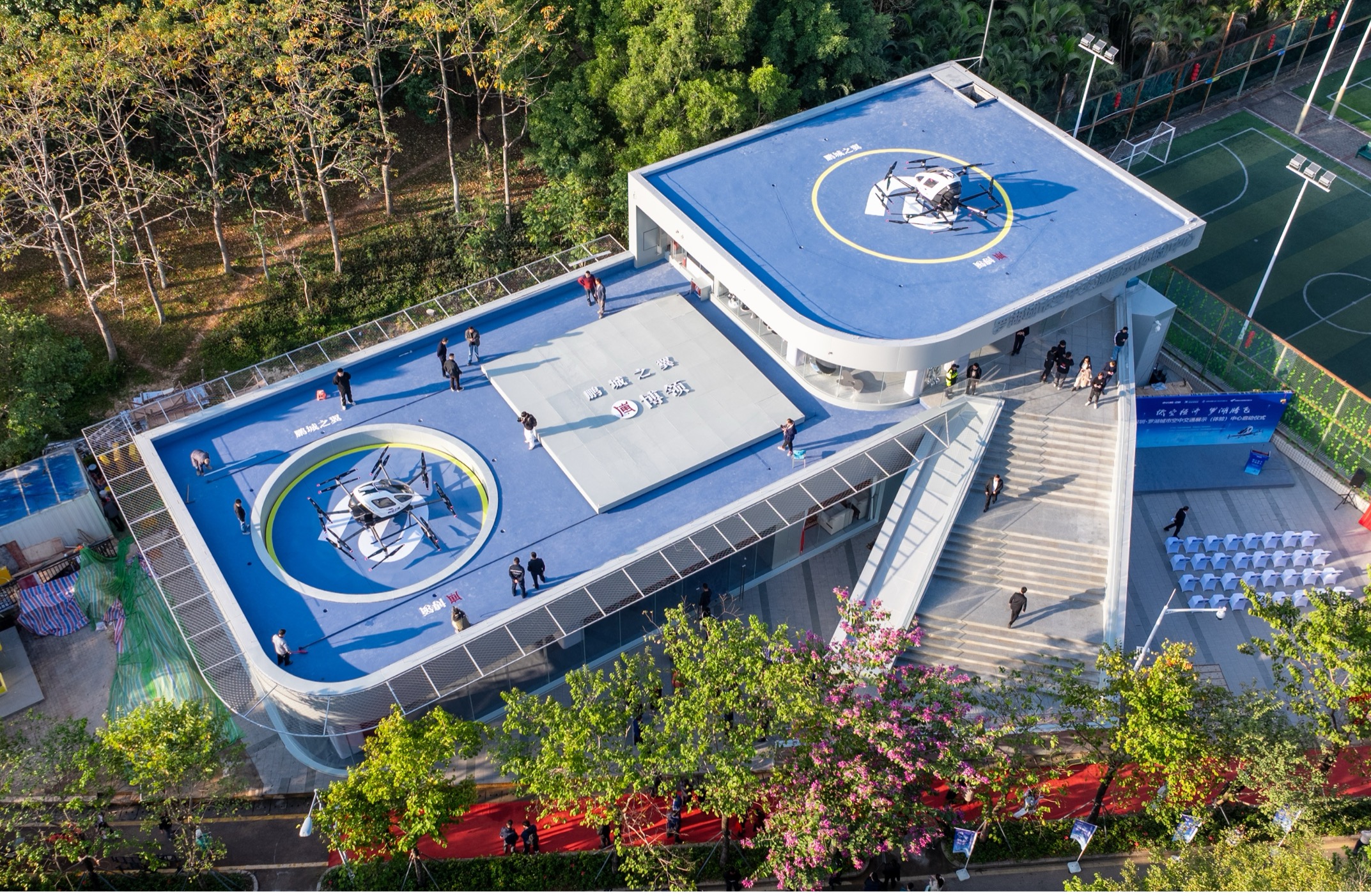
In Shenzhen, for example, plans are reportedly afoot to construct over 1,200 takeoff and landing sites for low-altitude aircraft, including drones, manned vehicles, air taxis, and logistics craft. As of mid-2024, it was reported that 249 such sites had been completed (the highest in the nation) and that the 1,200 target would be reached by 2026. While it is difficult to determine how many of these Shenzhen sites might eventually accommodate passenger carrying eVTOLs, the Luohu District had 15 purpose-built vertiports by January 2025, including the Urban Air Mobility Exhibition (Experience) Center at Luohu Leisure Park.
UAM Exhibition (Experience) Center in Shenzhen’s Luohu District
Source: EHang Holdings Limited
By 2026, the district plans to have 100 take-off and landing sites, with 32 of these designed for passenger-carrying aircraft. If we were to apply that 32% share throughout the entirety of Shenzhen and assume all plans come to fruition, it could be reasonably inferred that there will one day be a total of 384 passenger vertiports in this city alone – a huge number by any standard. Indeed, according to Unmanned Publications’ latest AAM/UAM market map, 980 vertiports are expected to be built between 2025-2029. If we take this as read, could just one city on Earth really account for nearly 40% of them?
Some 900 miles northwest of Shenzhen, deep inland along the Yangtze River, Chongqing’s authorities have even loftier ambitions. Here, the plan calls for more than 1,500 new general aviation take-off and landing points by 2027. As of November 2024, Chongqing had already initiated 28 key low-altitude projects, supported by an investment of 29.4 billion yuan (approximately $4 billion), and recorded a 60% increase in low-altitude flight hours. And it’s not just infrastructure – Chongqing is cultivating a full ecosystem, rolling out a low-altitude economy pilot zone in the Liangjiang New Area focussed on heavy-lift cargo drones and integrated UAM logistics.
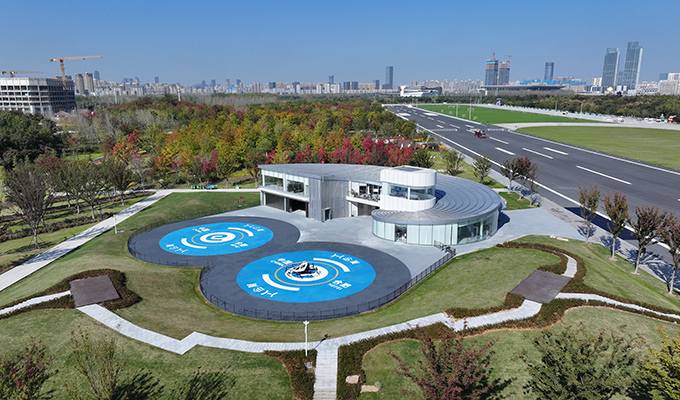
Beyond the headline-grabbing announcements in Shenzhen and Chongqing, a host of other Chinese cities are also moving forward with sizeable infrastructure programmes. In Hefei, progress is already visible with two vertiports up and running in Luogan Park with leading Chinese eVTOL manufacturer, EHang. Suzhou is talking about a backbone network by 2026 – one or two general airports and more than 200 eventual VTOL points, some retrofitted from existing helipads. Hangzhou’s target is bigger still at 275 by 2027. Nanjing is aiming for 240 by 2026, while Wuxi, though starting smaller with seven helicopter pads and 32 routes already in operation, ultimately plans around 200 facilities by the same point in time.
Urban Air Mobility Hub at Luogang Central Park in Hefei
Source: EHang Holdings Limited
Given the sheer scale and pace of construction outlined, the reader would be forgiven for thinking that all large urban conglomerations are poised for a similar tidal wave of vertiport activity, with China’s eventual tally of pads therefore running into the tens of thousands. However, activity elsewhere is comparatively muted. China’s fifth largest city, Guangzhou, for instance, has set its sights on a much more modest 100 sites – a strikingly conservative figure considering both its size and proximity (less than 100 miles) to EHang’s premier production facility in Yunfu. And in Chengdu, the nation’s fourth biggest city, authorities have stayed coy on actual vertiport numbers, instead announcing the creation of six drone delivery routes and 12 delivery points. Both cities, it seems, are taking a more measured approach, starting with logistics before pushing further into ferrying people around. This strategy makes sense as a low-risk proving ground, allowing technologies and regulations to mature before scaling to the much higher-stakes realm that is passenger transport.
And We Could Count 4,000 Sites
All in all, after totting up the totals of all known developments across the country, our calculations show there could be up to 4,000 take-off and landing sites in operation in China in short order. In fact, a report published by China’s Low Altitude Economic Alliance in November 2024 claimed that “in about two to three years, air traffic networks and ground flight service facilities in China’s major cities will be largely completed”. In other words, much of this could be ready as early as 2027. Then again, the same report also predicts 100,000 eVTOLs in operation in this one nation by 2030. As trendsetting as China may be, that’s a number we struggle to find plausible – unless, of course, it sweeps in the myriad of drones, many of them commercial, already buzzing around over Sino skies.
Of course, a “site” could be anything from a simple circle painted on the tarmac of a regional airport, all the way up to an all-singing, all-dancing vertiport with multiple pads and standard passenger processing facilities, as well as anything in between. Valour Consultancy’s conservative estimate is that, by the end of 2025, there will be around 35 passenger-carrying “vertiports” built out of a total of 500 take-off and landing platforms across the country. We use the term vertiports loosely, as this will inevitably consist of a handful of urban greenfield developments similar to the photos shown in this article; some heliports fitted with electric charging points and the like, plus an array of basic setups that have sprung up in places like Wencheng County and Taiyuan to support initial sightseeing operations of EHang’s EH216-S eVTOL.
Regardless, if we take our 2025 calculation – 35 out of 500 sites, or around 7.1%, built for passenger operations – and apply that same ratio to the ~4,000 seemingly planned, we arrive at about 280 passenger vertiports. Factor in continued but more tempered post-peak build activity through the latter part of the decade, and the number could quite easily edge past 300. And while that may sound like a lot, especially against the backdrop of minimal activity in other parts of the world, it is probably not too unreasonable once you dig into local market dynamics:
- First, China is not blessed with a vast network of heliports. In fact, we put this number at 286, which pales in comparison with the more than 8,000 found in the United States. Our belief, as we’ll explore in Part II of this analysis, is that much of the supporting infrastructure for passenger eVTOLs outside of China will come in the form of retrofitted heliports and helipads. And in this sense, China is well behind many of its peers, necessitating the kind of aggressive greenfield builds being predicted. To put that into perspective, a leading helicopter manufacturer recently told us that the Chinese market could easily absorb several thousand additional choppers – the demand is there, even if the infrastructure is not (yet).
- Second, passenger eVTOL is already a reality in China and the entirety of the world’s in-service fleet – albeit small – resides there. To put this into perspective, EHang’s public filings show that it has produced 289 units up to the end of 2024 (which includes a small number non-passenger carrying variants) to date. And if its revenue guidance is to be believed, the company is in line to deliver at least another 400 more this year. What’s more, CAAC certification of competing vehicles from Autoflight, Aerofugia and TCab Tech looks likely to come in the not too distant future and these will all need somewhere to take off and land from.
Who Will Follow?
China is clearly setting the pace on vertiport development, and while the numbers may at times feel outlandish, we’d do well to remember that they’re underpinned by a unique policy environment, a fast-maturing domestic eVTOL industry, and a chronic shortage of existing rotorcraft infrastructure to meet latent demand. The rest of the world is not even close to matching the conditions that exist here, making China both a test case and an outlier. Cities like São Paulo have long demonstrated how urban air mobility can function with helicopters, but what’s happening in China is the first genuine template for how eVTOL infrastructure might actually roll out. Whether 300 passenger-capable vertiports by 2030 proves too high, too low, or oddly prescient, one thing is certain: China is already writing the opening chapter. The bigger question – and the subject of Part II – is whether anyone else will follow.
Valour Consultancy’s forthcoming report: “The Future of Advanced Air Mobility – 2025” aims to deliver a credible, detailed, and objective assessment of this burgeoning market. It considers not just passenger platforms and the associated infrastructure required, but also cargo transport, deliveries and inspections using commercial-grade uncrewed aircraft systems (UAS, commonly referred to as drones), as well as surveillance and specialist missions such as medevac, firefighting, and search and rescue.