Introduction
After releasing an article into the world, most authors experience a brief mixture of anxiety, excitement and trepidation.
Will our readers like it? Will they find it useful? Will people think I am a plonker? More importantly, will my mother still love me?
Usually, yes to all of the above. Although she occasionally has notes.
In the case of our recent Five Strategic Takeaways from the Maritime Autonomous Vessels and USV Ecosystem, the suspense lasted approximately three hours.
I received an email, followed later that day by a telephone call from a very well-spoken gentleman. Do not worry, it was not Duke Eddie Horniman, Stanley Johnston or anyone else associated with the Glass family. His name was Antoon Van Coillie of Zulu Associates Group.
The call began with something along the lines of:
“That was a nice article about USVs. Boys and their small toys. But do you want to know what the big boys are doing and what is really happening?”
It was a strong opening. Subtle, diplomatic and carefully designed to make my recent research feel as though I had spent several months studying remote controlled bath toys.
The ZULU MASS Proposition
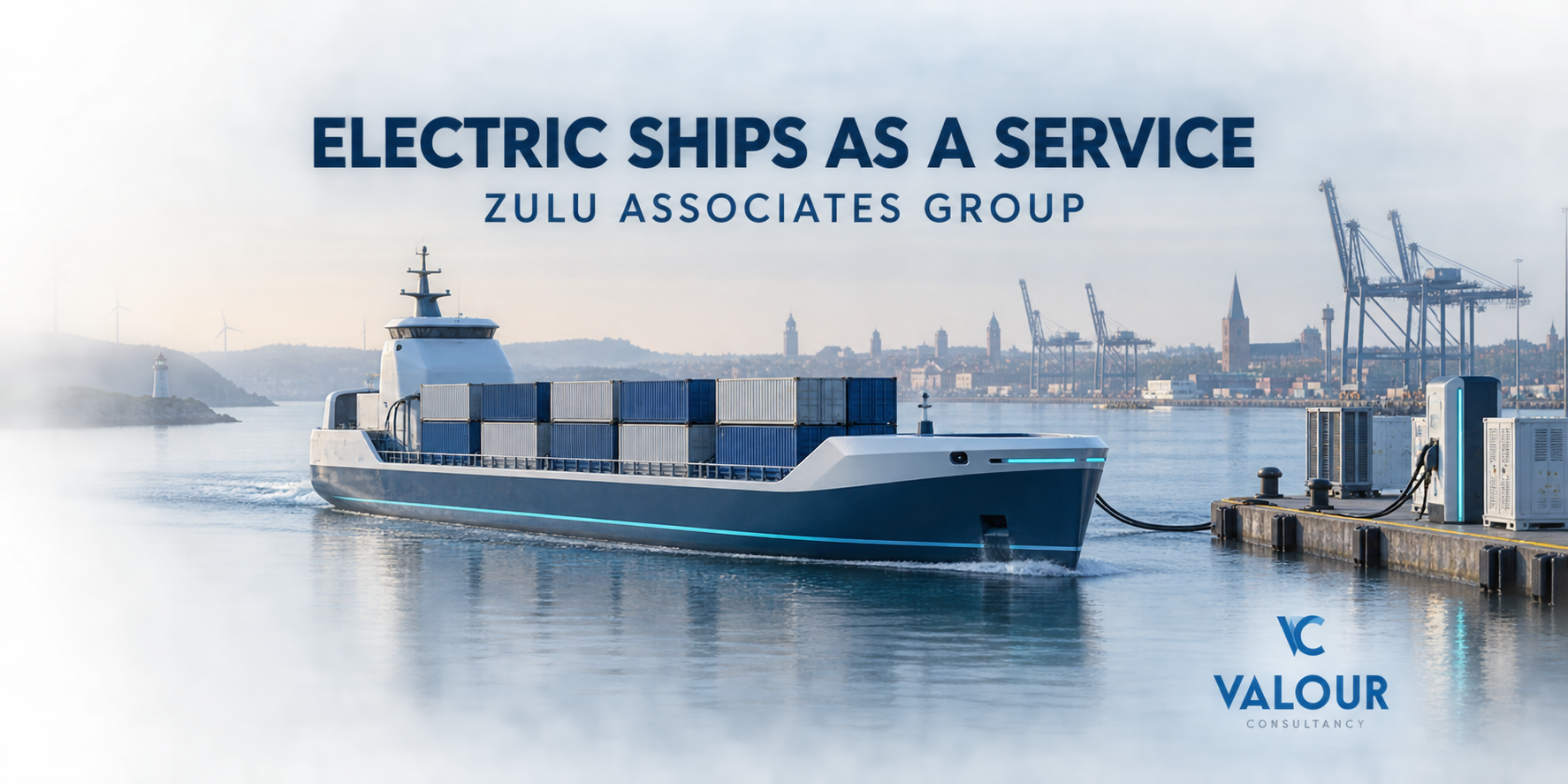
Zulu Associates Group is a Belgian maritime innovator developing zero emission commercial vessels for short sea, coastal and inland waterway routes. It describes itself as an initiator, developer and future operator of innovations within the marine component of logistics chains. Its proposition combines alternative propulsion, autonomous operation and a different commercial model.
The flagship concept is ZULU MASS, a purpose built marine autonomous surface ship. The proposed vessel is 105 metres long, has a stated capacity of approximately 210 TEU and is intended initially for direct container and feeder services that connect rivers with the sea. Zulu estimates a vessel price of €12.5 million.
Electric motors would drive the vessel, while containerised batteries or hydrogen-based power modules would provide energy. The modular arrangement is intended to separate the ship from a single energy carrier. Modules could be exchanged in port for charging, maintenance or replacement, and the vessel could theoretically adopt a different energy source later without extensive structural changes.
Zulu’s presentation schedules the start of construction by the end of 2026 and 2027, testing during 2027 and commercial operations from 2027 or 2028. These remain development targets rather than confirmed delivery dates. Progress will depend on financing, shipyard capacity, regulatory approval, insurance, customer commitments and successful trials.
Where the Model Could Work
Zulu is not presenting battery power as a universal replacement for marine fuel. Its strongest application is a repeatable regional route with predictable energy demand, suitable ports and regular cargo volumes. The proposed first service would connect the Scheldt and Thames estuaries over approximately 120 nautical miles. Zulu estimates a voyage of around 12 hours and an energy requirement of 12 to 16 MWh.
That corridor offers several advantages. The distance is short enough for batteries to be considered, while multiple ports could spread charging demand and provide some operational redundancy. Much of the route can be covered by terrestrial communications, supplemented by satellite connectivity. Existing freight flows could also support a modal shift from road transport. According to Zulu, preliminary discussions indicate potential demand for between two and six vessels, although expressions of interest are not the same as firm charter commitments.
Rather than selling each vessel, Zulu plans to offer cargo capacity through a Ship as a Service model. A shipper would purchase capacity within a defined geographical area under an arrangement broadly based on time chartering, with Zulu or its partners providing the vessel and associated operational services. This could reduce the customer’s need to invest directly in unfamiliar electric and autonomous technology.
The model does not remove commercial risk. It transfers more of that risk to Zulu, its investors, energy suppliers and operating partners. The economics will therefore depend on vessel utilisation, dependable cargo volumes and the ability to spread shore based operating costs across a fleet rather than one or two ships.
Testing the Battery Economics
Zulu’s argument begins with an uncomfortable fact: alternative energy can cost more than fossil fuel for each kilowatt hour delivered. Its answer is to reduce the energy required to move each tonne of cargo and recover further savings from simpler propulsion, unmanned operation and higher vessel utilisation.
In a company presentation, the firm assumes diesel at €0.88 per litre, producing a slightly lower cost per tonne kilometre than battery power. However, recent fuel price increases materially change the comparison. Battery propulsion reaches approximate energy cost parity when diesel rises above €0.93 per litre. At an indicative diesel price of €1.12 per litre, the diesel vessel would cost approximately €101 per operating hour and €0.0047 per tonne kilometre, compared with €70 per hour and €0.0039 per tonne kilometre for the battery vessel. Battery power would consequently be around 17% cheaper on an energy cost basis. This strengthens Zulu’s argument, although the result remains sensitive to fuel and electricity prices and does not include battery, charging infrastructure or financing costs.
However, the battery vessel carries less cargo. Zulu’s own calculation therefore produces a slightly higher cost per tonne kilometre: €0.0039 for battery power compared with €0.0036 for diesel. The figures support a case that battery propulsion is approaching energy cost parity, but they do not demonstrate that it is already cheaper on a comparable cargo basis.
It is also important to distinguish this inland vessel example from ZULU MASS. A vessel consuming 200 kWh per hour would use approximately 2.4 MWh during a 12-hour voyage. That is well below Zulu’s separate estimate of 12 to 16 MWh for the larger Scheldt to Thames concept. The two cases illustrate the same principle, but they are not the same vessel or business case, readers should note.
A complete assessment would need to include battery leasing or acquisition, degradation, charging losses, grid connection and demand charges, module handling, remote operating centre expenditure, communications, cybersecurity, insurance and the cost of capital.
Zulu expects battery prices and energy density to improve, and surplus renewable electricity could lower charging costs. Those benefits remain sensitive to location, charging time and the commercial terms agreed with energy providers.
Designing the Ship Around the Energy
Zulu believes a battery powered unmanned ship should be designed from the hull upwards. Its proposed hull has been assessed using computational fluid dynamics and towing tank testing to reduce resistance in both open and confined waters. Lower resistance matters because every avoided kilowatt hour reduces the battery capacity, weight and charging infrastructure required.
Removing permanent crew accommodation, hospitality facilities and supporting systems could release space, reduce weight and lower onboard energy demand. Standardised construction may also support series production and simplify maintenance. Containerised energy modules would turn charging into an exchange process, although ports would still need suitable lifting equipment, safe storage, electrical capacity and common technical standards.
Zulu is sceptical about converting older ships. Existing hulls were generally designed around diesel propulsion and crewed operation. Alternative propulsion can be difficult to install and certify, while each vessel may require a different combination of sensors, control systems, redundancy and digital modelling. Accommodation also remains part of the vessel after conversion, even if it is no longer needed during normal passage.
There is nevertheless a counterargument. Retrofitting can extend the useful life of existing assets and may offer a faster, less capital intensive route to partial decarbonisation. Hybrid propulsion, decision support and assisted autonomy do not require every operator to proceed immediately to a fully unmanned newbuild. Constructing a new ship also creates embodied emissions. The right choice will depend on vessel age, route, remaining life and the depth of the proposed transformation.
Unmanned Does Not Mean Labour Free
Zulu defines unmanned operation as no crew being carried during passage. Sensors would provide awareness of the external environment and internal ship systems, while onboard software would execute the route, apply collision regulations and initiate fallback actions. A remote operating centre would monitor the vessel and intervene according to the circumstances.
The company argues that this could remove crew related accommodation costs, support continuous operation, improve schedule adherence and reduce some forms of human error. It could also respond to shortages in the seafaring workforce and move some maritime employment into shore based technical roles.
The savings should not be treated as the removal of labour. Remote operators, maintenance engineers, port personnel, cybersecurity specialists and emergency responders will still be required. The commercial advantage will depend partly on the number of vessels that one remote operating team can supervise safely. That ratio will be influenced by traffic complexity, communications reliability, weather and the frequency of human intervention.
Autonomy can also introduce different risks. A vessel must continue safely when communications are interrupted, sensors disagree or a component fails. Cybersecurity becomes a safety issue when propulsion, navigation and shore control are connected. The absence of crew also complicates fire response, machinery repair, cargo incidents and physical security during a voyage.
Safety Regulation and Infrastructure
Zulu benefits from operating in a region where governments have already supported autonomous shipping trials. Belgium, Denmark, France, Germany, the Netherlands, Norway and the United Kingdom have worked through a memorandum intended to improve cooperation and harmonise applications. Belgium has a national framework, and Flemish waterways provide an exemption route for autonomous or remotely operated vessels.
The wider international framework is also progressing. The IMO adopted a non-mandatory MASS Code in May 2026, effective from 1 July 2026. This provides a clearer safety framework, but it does not remove the need for flag state approval, route specific permissions, port acceptance, classification, insurance and agreement over the responsibilities of the vessel and remote operating centre.
Battery safety is another consideration. Marine battery systems require protection against thermal runaway, fire and the release of flammable or toxic gases. The European Maritime Safety Agency notes that international requirements remain distributed across class rules, industry standards, codes and non-mandatory guidance. Battery rooms or containers therefore require appropriate segregation, ventilation, detection, cooling and emergency procedures.
The environmental claim also needs qualification. A battery vessel produces no direct propulsion emissions during operation, but its full carbon footprint depends on the electricity used for charging, battery manufacture and replacement. Zero emission at the point of operation is therefore more precise than claiming that the entire service is automatically zero emission.
Conclusion
Zulu Associates is proposing more than an electric propulsion package. Its commercial case depends on matching an efficient hull, modular batteries, autonomous operation, shore control, charging infrastructure and a repeatable logistics corridor. The elements reinforce one another. A more efficient hull reduces battery requirements, while lower onboard labour and accommodation costs may help offset the higher price of alternative energy.
The Scheldt to Thames proposal is a sensible test case because its distance, cargo flows and concentration of ports place limits around the problem. Success on that corridor would demonstrate the viability of a particular regional service. It would not prove that batteries and unmanned operation are suitable for every merchant vessel or trade route. Transocean journeys may be a step too far for battery powered merchant vessels.
Several uncertainties remain. The illustrative energy comparison is not a complete total cost of ownership model, and Zulu’s battery vessel remains slightly more expensive per tonne kilometre in the example presented. Infrastructure, battery safety, regulatory approval and remote operating costs could all affect the result. The timetable to begin commercial operations in 2027 or 2028 is also ambitious for a new vessel, operating model and cross border regulatory arrangement.
Nevertheless, the underlying argument deserves attention. Adding batteries and autonomous equipment to an inefficient conventional ship may preserve many of the costs that the technology is intended to remove. Zulu’s answer is to redesign the vessel and logistics service together. If it can convert customer interest into firm cargo commitments and demonstrate safe operations, ZULU MASS could become an important test of whether short sea autonomy can move beyond trials and into routine commercial shipping.
Valour Consultancy provides market intelligence on vessel autonomy, maritime connectivity and the technologies reshaping commercial shipping. Explore our maritime research or contact us to discuss our reports, market data and custom analysis. For more information on our maritime research, click here.