Introduction
Much of the discussion surrounding automated and smart shipping focuses on navigation, propulsion, remote operations and artificial intelligence. Yet one of the industry’s biggest opportunities to improve safety, efficiency and profitability lies somewhere far less glamorous: cargo handling.
For many commercial applications, automated shipping is perhaps the more appropriate term than autonomous shipping. While computing systems are becoming increasingly capable of making operational decisions, commercial shipping is likely to retain human oversight for many years, with experienced operators authorising critical decisions while automation performs an increasing share of routine operations.
Cargo handling affects every sector of maritime trade, from containers and dry bulk to oil, gas, timber, refrigerated cargo and Ro-Ro operations. According to the European Maritime Safety Agency (EMSA), which covers the 27 EU member states plus Norway and Iceland, 2,659 marine casualties and incidents were reported during 2024. Around half occurred in ports or inland waters, with many involving cargo handling, loading operations or cargo loss.
This article provides a broad overview of how automation could transform cargo handling. Future articles will examine individual cargo sectors and explore the unique challenges and opportunities each presents.
The reality of autonomous shipping is not really about ships, communication, crewing and propulsion; it is about trade and moving product.
Maritime Trade
Trade is essentially a pipeline connecting miners, farmers, fishermen and manufacturers with consumers around the world. Ships form one section of that pipeline alongside rail, road and air transport.
Every blockage delays commerce, every leak creates unnecessary cost, waste or cargo loss.
For shipping, those blockages include geopolitical conflict, port congestion, labour shortages and industrial action. The leaks are piracy, accidents, weather-related losses, cargo damage and operational inefficiencies.
Port automation has understandably concentrated on container terminals because containers provide highly repeatable handling processes. However, every cargo type presents different operational challenges. Oil requires transfer arms and stringent safety procedures. LNG has cryogenic handling requirements. Dry bulk depends on conveyors and grabs. Timber, fish, Ro-Ro cargoes, ferries and cruise operations all require their own specialised handling systems.
While every cargo sector demands different equipment, they increasingly share something in common: digital planning, automation, advanced sensors and computing power.
A Future Automated Port
Imagine one of the world’s busiest ports such as Shanghai, Singapore, Rotterdam, Shenzhen, Busan, Los Angeles, Long Beach, Port Klang or Ningbo-Zhoushan.
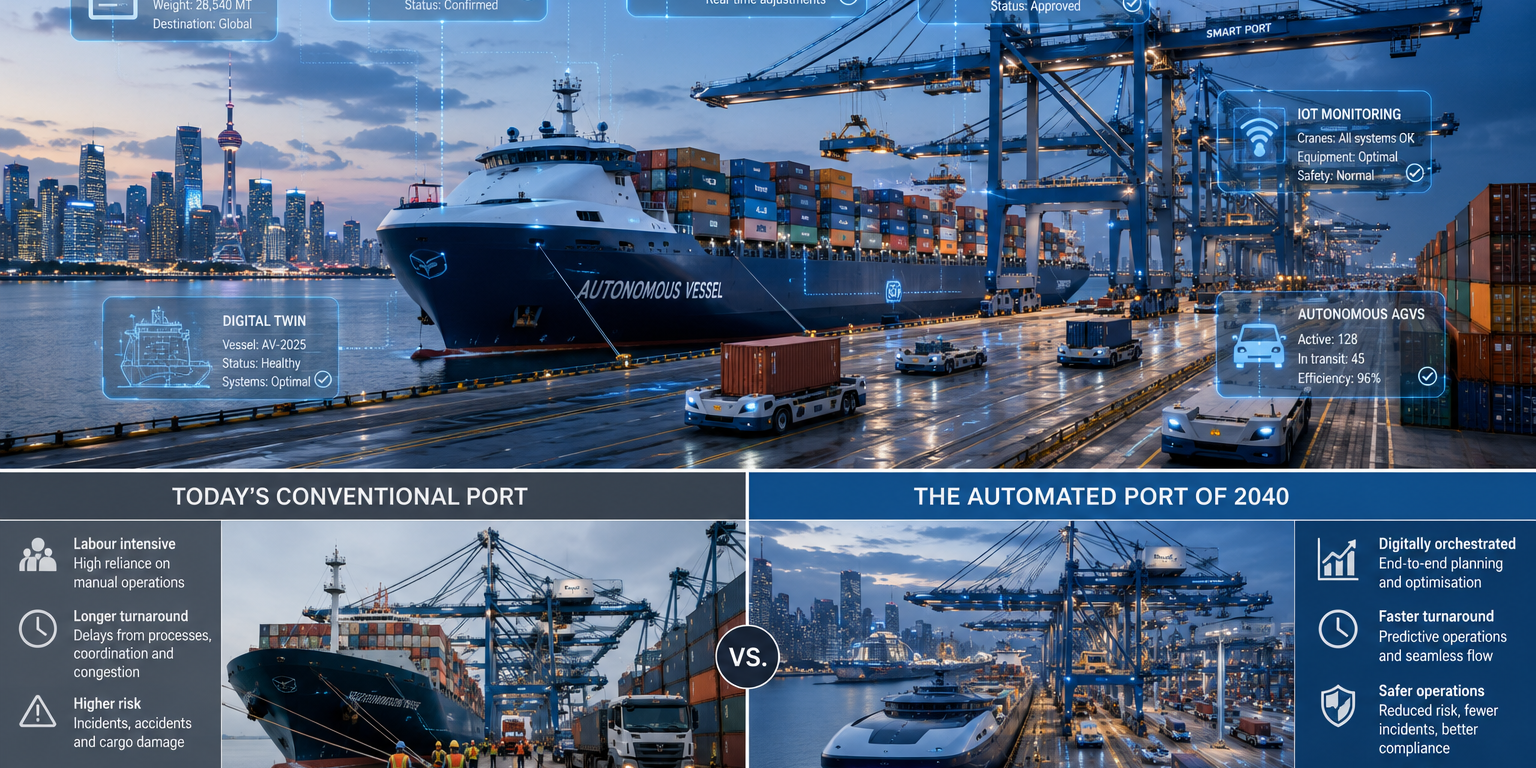
Approximately 24 nautical miles from port, an automated vessel establishes a secure digital connection with the port authority. Cargo manifests, customs documentation, dangerous goods declarations, stability information and estimated arrival times are transferred automatically. Digital systems allocate an optimum berth, reserve cranes and handling equipment, schedule customs inspections where necessary and coordinate onward transport before the vessel even arrives.
Around three nautical miles from the harbour entrance, control passes seamlessly to the port’s vessel traffic management system. Automated tugs position the vessel alongside its berth, where vacuum mooring or another automated mooring solution secures it without the need for traditional mooring lines.
Cargo handling equipment is already waiting. Cranes, loading arms, transfer hoses or vehicle ramps connect automatically where practical. Onboard cargo management systems have already calculated and verified the unloading sequence to maintain vessel stability throughout the operation. Cargo is transferred efficiently to automated guided vehicles, terminal tractors, conveyor systems or storage facilities, while artificial intelligence continuously monitors equipment performance and cargo movements for anomalies or safety concerns.
Once unloading is complete, cargo is rearranged or reloaded as required before the vessel departs with minimal delay.
Perhaps the most interesting aspect of this scenario is that very little of the technology is fictional. Most of these individual systems already exist. The challenge is not inventing the technology; it is integrating the different systems into one seamless commercial operation. Until larger numbers of automated vessels enter service, the return on investment for fully automated ports remains difficult to justify.
It may need a far-sighted (former) trillionaire to get his mind back to earth and ocean.
Conclusion
The immediate benefits would extend well beyond simply reducing labour requirements. Automated cargo handling could reduce pilot transfer accidents, ship collisions during port approaches, rushed manoeuvring during the final miles of a voyage, cargo handling incidents and pollution resulting from operational mistakes.
Commercially, the benefits could be even greater. Every additional hour a merchant vessel spends alongside is an hour it is not earning revenue. Improving turnaround times by even a few percentage points across a fleet can generate millions of dollars of additional asset utilisation each year.
Better cargo planning reduces delays and demurrage. Better cargo planning reduces delays and demurrage. Continuous digital monitoring helps reduce cargo damage, insurance claims and equipment downtime. More efficient loading and unloading also reduces emissions while improving the utilisation of valuable port infrastructure.
Busy waterways such as the Baltic Sea, the Strait of Malacca and the English Channel could also benefit from improved traffic management, greater situational awareness and enhanced maritime security.
The greatest challenge, as always, is economics. The technology largely exists today. The real challenge is justifying the investment while geopolitical uncertainty and fragmented global trade make long-term infrastructure decisions increasingly difficult.
Singapore is already embracing the challenge with the Tuas Megaport, which is scheduled to be finished in 2040 and will feature automated cranes, cargo containers, intelligent control systems, and sustainable technology, including unmanned vehicles and automated yard cranes. The port waters will also be monitored and managed using digital sensors and software to keep track of key water quality characteristics.
Yangshan Deep Water Port in Shanghai is the world’s largest automated container terminal, including crane, truck, and vehicle automation. Using a 5G network, it offers full terminal automation, blockchain cargo tracking and documentation, 5G Integration, and AI Scheduling.
Rotterdam and Hamburg use digital twins to schedule docking and IoT to oversee machinery. Even Vancouver (Canada), Chancay (Peru), Veracruz (Mexico) and Long Beach (USA) have adopted many smart port technologies.
Nevertheless, the future of automated shipping will not simply be determined by smarter ships. It will be shaped by smarter ports, smarter cargo handling and smarter trade. The pace of change is accelerating and those major ports failing to move with the times will be at a severe disadvantage.
For our latest research in autonomous shipping, and upcoming reports on commercial smart shipping and smart ports and terminals, click where appropriate.